Module 1 / 2
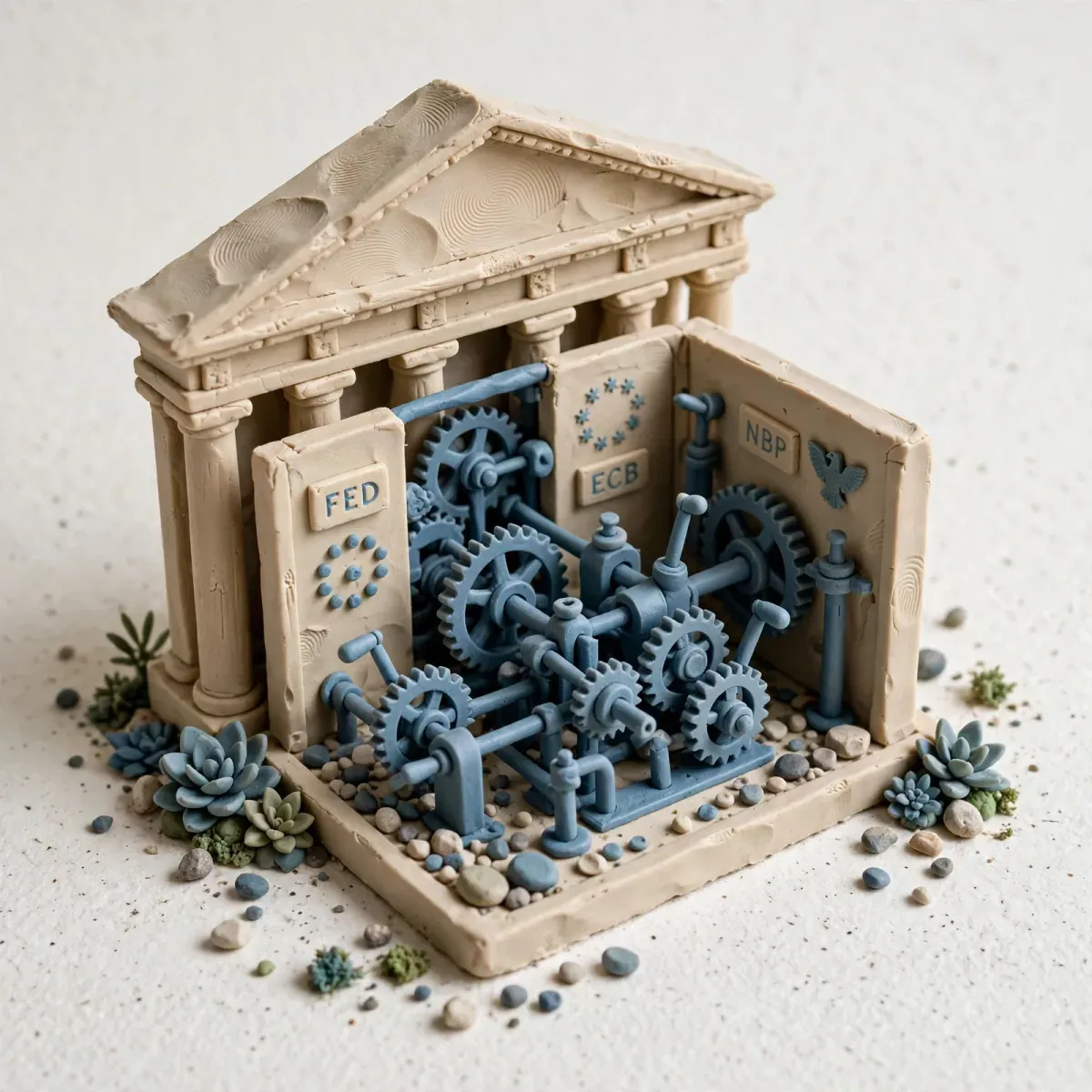
Central banks - the Fed, the ECB, the NBP
A central bank is not a bank. It has no customers, it does not maximise profit, it holds a monopoly on creating base money and it is the lender of last resort. Understanding its mandate, its tools and its balance sheet is understanding where the price of money comes from - the interest rate - and therefore...
- Author
- Zordon Intelligence Sp. z o.o.
- Updated
- 7 min read
- Structure sources
- 2
A central bank is not a bank. It has no customers, it does not maximise profit, it holds a monopoly on creating base money and it is the lender of last resort. Understanding its mandate, its tools and its balance sheet is understanding where the price of money comes from - the interest rate - and therefore the price of every asset on the market.
Mandates - three different philosophies
| Bank | Year founded | Legal mandate | Inflation target | How does it measure it? |
|---|---|---|---|---|
| Fed (USA) | 1913 | Dual mandate: price stability + maximum employment | 2% PCE average | PCE, tolerates overshoots |
| ECB (euro area) | 1998 | Primary: price stability, secondary: support EU policies | 2% symmetric HICP | HICP, medium term |
| NBP (Poland) | 1945/1989 | Price stability, supporting the government’s economic policy if it does not conflict | 2.5% CPI +-1pp | CPI, continuous target |
The difference is crucial: the Fed can legally tolerate higher inflation in order to lower unemployment. The ECB treats price stability as an absolute priority (the lesson of Germany’s hyperinflation in 1923). The NBP has a 2.5% target with a +-1pp band, that is de facto 1.5-3.5%, higher than the ECB, because the economy is a converging one.
Tools - how does a central bank influence the market?
1. The price of money - interest rates
- Reference rate / fed funds rate / NBP reference rate: the rate at which the central bank lends short-term to commercial banks (or absorbs the surplus).
- Transmission channel:
CB raises rates → more expensive interbank credit (WIBOR, SOFR, €STR)
→ more expensive credit for companies and mortgages
→ lower demand for credit → less money creation (M3 slows)
→ lower consumption and investment → lower pressure on prices (with a 12-18 month lag)
→ more expensive money → higher cost of holding a leveraged position → falling prices of risky assets
2. The quantity of money - balance sheet operations: QE and QT
- QE (Quantitative Easing): The central bank buys government / corporate bonds on the market, paying with newly created reserves. It does not “print cash”, it only exchanges a bond (a long-term asset) for reserves (overnight liquidity). The goal: to lower long-term rates when short-term rates are already at zero.
- QT (Quantitative Tightening): The opposite - it does not reinvest maturing bonds. Reserves disappear from the system.
Example of a simplified balance sheet:
QE of 100 bn:
CB assets: Bonds +100 bn
CB liabilities: Bank reserves +100 bn

Commercial bank:
Assets: Reserves +100 bn, Bonds -100 bn (it sold them)
Fed: from USD 900 bn in 2008 to 9000 bn in 2022, then QT down to 7700 bn. The ECB likewise.
3. Reserve requirements, open market operations, forward guidance
Forward guidance is a verbal promise - “rates will stay low for a long time”. In a world of algorithms, the words of a governor are a stronger tool than a 25bp hike.
Decisions - how do you read them like a trader?
You do not trade the decision, you trade the surprise versus expectations. The market prices in 90% of the decision before the meeting.
Where to look:
| Timing | What to monitor | Tool |
|---|---|---|
| 2 weeks before | Members’ statements (Fedspeak, ECBspeak) | Speech calendar |
| 1 week before | Market rate expectations | CME FedWatch, ESTR forwards, FRA for WIBOR |
| Decision day | Statement + projections (Fed dot plot, ECB/NBP staff projections) | Statement |
| 30 minutes after | Governor’s press conference - hawkish/dovish tone | Language: “data dependent” vs “determined” |
Formula for pricing the surprise:
Surprise = Actual_decision - Median_market_expectation

Example: The market prices an 85% chance of a 25bp hike and 15% of no change.
The RPP raises by 0bp (as on 7 Sep 2023 - a 75bp cut when the market expected 25bp).
→ Dovish surprise - PLN weakens 2% in 15 minutes.
That is why a professional never goes in blindly before a decision without a plan for both scenarios and a position size adjusted for volatility.
The NBP - local specifics
The Monetary Policy Council (RPP, Rada Polityki Pieniężnej) - 10 members: the NBP Governor plus 9 appointed three each by the Sejm (the lower house of the Polish parliament), the Senate and the President. Decisions are taken by majority vote.
The NBP additionally has: FX interventions (buying/selling EUR/USD for PLN) to influence the exchange rate. In December 2020 the NBP intervened, weakening PLN (the Polish zloty) from 4.45 to 4.55 EUR/PLN in a single day.
NBP reserves: about USD 190 bn (2024) - mainly in USD, EUR and gold (360 tonnes). It is a safety cushion.
When the plan says: do not trade
- 15 minutes before and 30 minutes after a Fed/ECB/NBP decision, if you have no plan for the surprise. Volatility can jump 5-10x. The spread on EUR/PLN on an RPP day can go from 20 pips to 200. A stop-loss becomes a lottery.
- When the governor is speaking and you have an open directional position without a hedge. One adjective, “persistent” instead of “transitory”, about inflation in 2021 changed the trend for 12 months. Do not fight Fed speak, wait for the transcript.
- When you have not checked the calendar. Trading the SP500 on an FOMC day without knowing about the FOMC is like driving without checking the fuel. The macro calendar is part of the plan, not an add-on.
Mistakes that cost the most
Mistake 1: Thinking that a low rate = always good for stocks. Up to a point, yes. But when rates are at 0% and the Fed starts hiking because the economy is overheating, at first the market ignores it, then it panics. History: 1999-2000, 2004-2007, 2021-2022. The yield curve inverts (10Y-2Y <0) - a signal that the market does not believe in a soft landing.
Mistake 2: Ignoring the balance sheet and looking only at rates. In 2022 the Fed was hiking rates and running QT at the same time - a double tightening. In 2019 the Fed was cutting rates, but the repo market froze - it had to run QE despite the cuts. The balance sheet is quantity, rates are price. You need both.
Mistake 3: Assuming that the NBP follows the ECB/Fed 1:1. Poland has its own cycle, its own inflation, its own exchange rate. In 2021 the ECB held at 0%, the NBP had to raise from 0.1% to 6.75%, because inflation in Poland was 17%. In 2023 the Fed held high, the NBP cut. Divergences are opportunities and risks on EUR/PLN and on bonds.
Measurable exercise
Goal: Build your own expectations vs reality dashboard.
Steps:
- Set up a table:
| Decision date | Bank | Market expectation (median) | Decision | Surprise (bp) | Market reaction in 1h (e.g. EUR/PLN, SPX, WIG20) |
|---|
- Over the next 4 meetings of the RPP, the Fed and the ECB, keep filling in the table. Sources of expectations: Bloomberg WIRP, CME FedWatch, the PAP (the Polish Press Agency) survey for the RPP.
- After 4 observations, calculate the correlation: does a dovish surprise (a bigger cut than expected) = a weaker currency / higher stocks? What was the average reaction in % to a 25bp surprise?
- On that basis, define a rule: “If the surprise is >=25bp dovish, I do not go long PLN for 24h” or a similar one.
This is measurement, not opinion. That is how an edge is built.
Check yourself
- Compare the Fed and ECB mandates. Which one can legally sacrifice inflation for employment, and how does that affect the reaction of the labour market?
- Explain the mechanism of QE: what does the central bank buy, what does it pay with, and why do bank reserves rise while cash in circulation does not necessarily?
- What is forward guidance, and why does it sometimes work more strongly than a rate change?
- How do you price the surprise of a decision? Where do you check market expectations before an RPP meeting?
- Why was the RPP cutting by 75bp on 15 August 2023, when the market expected 25bp, a shock for PLN? Calculate the surprise in basis points.
Frequently asked questions
Can the NBP go bankrupt? Not in the currency it issues. It can have negative equity (like the SNB or the Fed in 2023), but it can keep operating, because its liabilities are in PLN, which it creates itself. The problem is credibility, not nominal solvency.
Why can’t a central bank simply print money and hand it out so that everyone is rich? Because wealth is not money, it is real goods and services. If you double the amount of money while the amount of bread stays fixed, the price of bread doubles. In the short term transfers can stimulate demand, in the long term only prices.
What is the dot plot? A chart of dots - the anonymous projections of FOMC members for future Fed rates. It shows the median and the distribution. The market loves it, but the Fed always says it is not a promise.
Are NBP interventions on PLN effective? In the short term yes - they can shift the exchange rate by 1-2%. In the long term no, if the fundamentals (inflation, rates) move the other way. Example: the SNB in 2011-2015 - it defended the peg, expanded its balance sheet to 80% of Swiss GDP and still had to give up.
Advertisement
Key takeaways
- A central bank is not a bank. It has no customers, it does not maximise profit, it holds a monopoly on creating base money and it is the lender of last resort. Understanding its mandate, its tools and its balance sheet is understanding where the price of money comes from - the interest rate - and therefore...
Structure sources
The material is based on source documents. Variable values — fees, limits, regulatory figures — are worth checking at the source before making a decision.
- Central banks — publications of the Fed, ECB, NBP (National Bank of Poland) — nbp.pl
- BIS — annual economic reports
Disclaimer
- Educational material. Not investment advice or a recommendation. Trading involves the risk of losing capital.
- The materials are educational. They are not investment advice or a recommendation within the meaning of financial instruments trading regulations. Numbers in examples are illustrative unless a measurement date and source are given.
Who writes this and how we check it
The materials are written and verified by Redakcja Kurs Tradera — the rules are described on about the site: every number has a source, and we show gaps openly. Report a factual error via contact — corrections are described in the content.
Progress is stored only in this browser (localStorage) — there is no account and no copy on the server. Clearing site data will remove it. Manage your data