Module 1 / 2
Fractional reserve banking and money creation
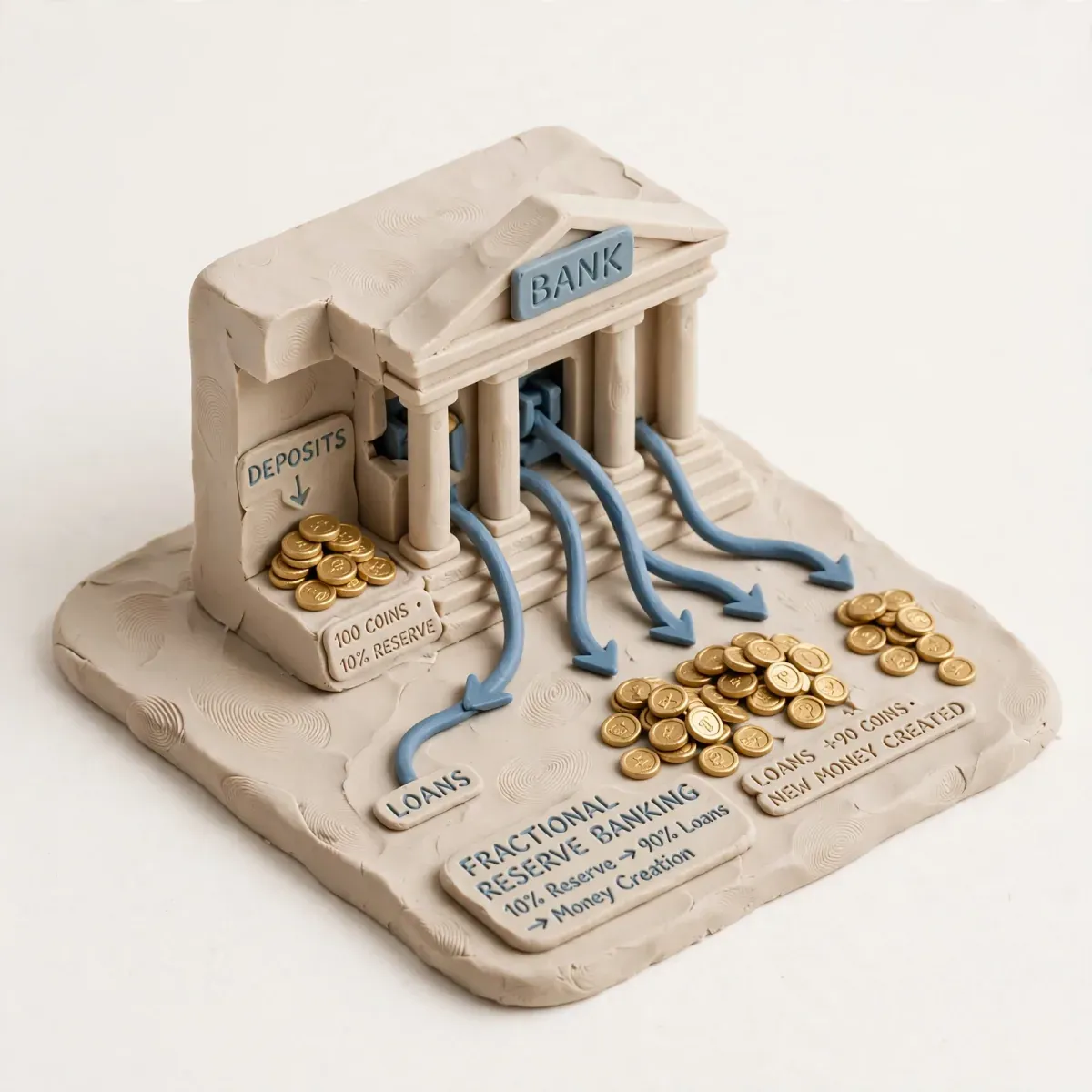
The biggest misunderstanding in finance: banks do not lend out your deposits. Banks create deposits when they extend loans. That single mechanism accounts for 90% of the money supply you see in your account. If you do not understand it, you do not understand inflation, banking crises and...
- Author
- Zordon Intelligence Sp. z o.o.
- Updated
- 7 min read
- Structure sources
- 2
The biggest misunderstanding in finance: banks do not lend out your deposits. Banks create deposits when they extend loans. That single mechanism accounts for 90% of the money supply you see in your account. If you do not understand it, you do not understand inflation, banking crises, or why a bank can collapse in 48 hours.
Two kinds of money
In the modern system there are two circuits, and they do not mix without an intermediary:
- Central bank money (M0, the monetary base): cash plus the reserves that commercial banks hold at the central bank. Only commercial banks and the state have access to it. You, as a citizen, have access only to the cash part.
- Commercial bank money (M1, M2, M3): the entries in your bank account. This is not central bank money. It is the bank’s promise to pay you central bank money (cash) on demand, or to make a transfer to another bank (using reserves).
When you pay by card in a shop, M0 does not move. Banks settle with each other in reserves through the Elixir / TARGET2 systems, but for you it is simply a change of numbers at two banks.
How is money created? The accounting of a loan
Suppose you take out a loan of PLN 400,000 for a flat. The bank does not check whether it has 400k from other depositors and it does not transfer them. It performs two accounting entries at the same time:
The bank’s balance sheet before:
| Assets | Liabilities |
|---|---|
| Reserves 50 million | Deposits 500 million |
| Loans 450 million | Capital 10 million |
At the moment the 400k loan is granted:
| Assets | Liabilities |
|---|---|
| Reserves 50 million | Deposits 500,400,000 (+400k) |
| Loans 450,400,000 (+400k) | Capital 10 million |
The bank created a deposit of 400k out of nothing, as the accounting counterpart of a new asset (your promise to repay). The M1 money supply rose by 400k in one second.
Only when you transfer that 400k to the seller of the flat at another bank does the bank need reserves to settle the transaction in the interbank system. If it does not have them, it borrows them on the interbank market (WIBOR) or from the central bank.
The key multiplier formula, simplified and outdated, but useful for teaching:
Simple_multiplier = 1 / reserve_requirement_ratio

In Poland the reserve requirement ratio: 3.5% since 2010.
Simple_multiplier = 1 / 0.035 = 28.57

In theory 1 PLN of reserves can support 28.57 PLN of deposits.
In practice the constraint is demand for credit and capital requirements, not reserves.
Modern banks are not constrained by reserves when creating credit, only by:
- Demand for credit from creditworthy customers
- Capital requirements (Basel III) - how much capital they must hold against risky assets
- Liquidity - whether they can settle outflows
- Risk appetite
Why can banks fail?
If a bank creates money, why does it fail? Because it runs on a maturity mismatch: it has short-term liabilities (your demand deposit - you can withdraw it tomorrow) and long-term assets (your 30-year mortgage). If everyone comes for cash at once (a bank run), the bank does not have that many reserves and that much cash.
Example, Silicon Valley Bank in 2023: USD 173 billion in deposits, 90% of them above the FDIC guarantee limit, invested in long-term Treasury bonds. When the Fed raised rates, the bonds lost value (interest rate risk). Clients (startups) began to withdraw. The bank had to sell bonds at a loss of USD 1.8 billion. Panic. Within 48 hours the bank no longer existed.
Fractional reserve banking is a system of trust. It works as long as not everyone tests it at the same time.
Money creation and inflation - the quantity equation
M * V = P * Q

M = money supply (e.g. M3)
V = velocity of circulation (how many times 1 PLN changes hands in a year)
P = price level
Q = real volume of transactions / GDP

A rise in M with V and Q constant -> a rise in P (inflation)
The problem: V is not constant. In the 2008 crisis M0 rose fivefold (QE), but V fell, because banks were not lending and people were not spending. That is why there was no hyperinflation straight away. Growth in M that reaches the financial market pumps up asset prices (stocks, real estate) before it reaches CPI.
| Type of creation | Who creates it | Where it goes first | Effect on CPI |
|---|---|---|---|
| Mortgage credit | Commercial bank | Real estate market | Indirect, with a lag |
| Consumer credit | Commercial bank | Consumption | Fast |
| QE - central bank buys bonds | Central bank | Bank reserves + bond market | Very delayed, through assets |
| Government credit (deficit financed by banks) | Banks + CB | State budget, transfers | Fast, if social transfers |
When the plan says: do not trade
- When the credit indicator of your broker/bank deteriorates. If your bank/broker has liquidity problems, rumours of a run, a falling CDS, your funds are at risk regardless of your positions. In the 2008 crisis, Lehman Brothers clients waited months to recover their collateral.
- When you trade banks without understanding the balance sheet. Buying a bank’s shares because it is “cheap, P/BV 0.5” without analysing the quality of the loan book, loss reserves and funding structure is a lottery. SVB had a low P/BV a month before it failed.
- When you ignore the reserves and liquidity calendar. Quarter end, year end, TLTRO, tax settlement - these are the moments when liquidity in the system falls. The bid-ask spread widens, slippage grows. A systematic trader reduces positions.
The most expensive mistakes
Mistake 1: Thinking that a bank deposit is risk-free cash. It is exposure to the bank’s credit risk. In the EU the guarantee is EUR 100,000. Above that - bail-in. In Poland the Bank Guarantee Fund (BFG) has a fund of about 3-4% of guaranteed deposits. In a systemic crisis what counts is the backing of the NBP and the state, not the fund alone.
Mistake 2: Confusing the monetary base with the money supply in circulation. The media shout “the Fed printed trillions”. Yes, M0 rose. But if loans do not grow, M3 does not grow. In 2020-2021 M3 in the USA rose 40% in 2 years - that was already creation by the government (direct transfers to accounts - fiscal + monetary). That is a difference you have to measure.
Mistake 3: Underestimating the destruction of money when a loan is repaid. When you repay loan principal, money is destroyed - the reverse of creation. The balance sheet:
Repayment of PLN 1,000 of principal:
Bank assets: Loans -1,000
Bank liabilities: Deposits -1,000 (from your account)

M1 falls by 1,000. Interest is the bank's profit, it does not destroy money.
In the deleveraging after the crisis (2009-2014), loan repayment destroyed money faster than banks created new money, which forced QE so that there would be no deflation.
Measurable exercise
Goal: Measure money creation in Poland.
Steps:
- Go to the NBP website -> Statistics -> M3 money supply. Download monthly data for the last 24 months.
- Calculate the year-on-year growth rate of M3:
M3_growth = (M3_t / M3_t-12 - 1) * 100%- Compare it with CPI inflation in the same months. Does M3 lead CPI? By how many months?
- Go to the KNF data - receivables from the non-financial sector. Calculate the share of mortgage loans in total creation. Is M3 growing through mortgages, or through loans to companies?
Write it down: if M3 grows 7% a year and real GDP 2%, then with constant V, how much is left for price growth (P)? 5%. That is your long-term inflation anchor.
Check yourself
- Describe step by step, in accounting terms, how a deposit comes into being with a loan of PLN 10,000. What changes in the bank’s assets and liabilities?
- How does central bank money differ from commercial bank money? Which one can you withdraw from an ATM?
- Why can a bank be solvent but illiquid and fail in 48 hours? Give the SVB example.
- What destroys money in a fractional reserve system? What happens when loan principal is repaid?
- Explain the equation MV = PQ. Why did the rise in M0 after 2008 not produce high CPI inflation straight away, but did produce asset inflation?
Frequently asked questions
Can banks create an infinite amount of money? No. They are constrained by demand for credit, capital requirements (they must hold, for example, 8-12% capital against risk-weighted assets), the LCR/NSFR liquidity requirements, and their lending policy. But in a boom these constraints are loose - hence credit bubbles.
What is the reserve requirement and does it still matter? In Poland it is 3.5% of deposits. In the USA, since March 2020 - 0%. The Fed concluded that it does not control the money supply with it, only liquidity. Today capital requirements and stress tests matter more than the reserve requirement.
Is my money in the bank safe? Up to EUR 100,000, yes, under an EU directive, guaranteed by the BFG. Above that - you are an unsecured creditor. In practice the state rescues large banks (too big to fail), but that is not a legal guarantee. Diversifying across banks above the limit is basic counterparty risk management.
Why is cash only 10-15% of M3? Because the system is based on credit. Cash is only the physical representation of a small part of liabilities. If everyone wanted to convert deposits into cash, there would not be enough physical cash - hence withdrawal limits in crises (Greece 2015 - EUR 60 a day).
Advertisement
Key takeaways
- The biggest misunderstanding in finance: banks do not lend out your deposits. Banks create deposits when they extend loans. That single mechanism accounts for 90% of the money supply you see in your account. If you do not understand it, you do not understand inflation, banking crises and...
Structure sources
The material is based on source documents. Variable values — fees, limits, regulatory figures — are worth checking at the source before making a decision.
- Central banks — publications of the Fed, ECB, NBP (National Bank of Poland) — nbp.pl
- BIS — annual economic reports
Disclaimer
- Educational material. Not investment advice or a recommendation. Trading involves the risk of losing capital.
- The materials are educational. They are not investment advice or a recommendation within the meaning of financial instruments trading regulations. Numbers in examples are illustrative unless a measurement date and source are given.
Who writes this and how we check it
The materials are written and verified by Redakcja Kurs Tradera — the rules are described on about the site: every number has a source, and we show gaps openly. Report a factual error via contact — corrections are described in the content.
Progress is stored only in this browser (localStorage) — there is no account and no copy on the server. Clearing site data will remove it. Manage your data