Module 1 / 2
From barter to Bitcoin - 5,000 years of the evolution of money
Money is not an object, it is a technology. A technology for measuring value, carrying it through time and settling obligations. Every trader who does not understand the evolution of money does not understand the market they trade. This lesson reconstructs 5,000 years of experiments - from...
- Author
- Zordon Intelligence Sp. z o.o.
- Updated
- 7 min read
- Structure sources
- 2
Money is not an object, it is a technology. A technology for measuring value, carrying it through time and settling obligations. Every trader who does not understand the evolution of money does not understand the market they trade. This lesson reconstructs 5,000 years of experiments - from shells to cryptographic code - and shows why every form of money failed or survived for the same reasons.
Why did money have to emerge?
Barter, that is direct exchange, has one fundamental flaw: it requires a double coincidence of wants. A farmer with wheat has to find a cobbler who happens to want wheat and has shoes. In an economy with 100 goods there are 4,950 exchange pairs. In an economy with 1,000 goods - 499,500 pairs. The cost of finding a counterparty grows exponentially.
Money solves three problems at once. First, it is a medium of exchange. Second, it is a unit of account - it lets you price everything on one scale. Third, it stores value over time.
Not every thing can perform those functions. Good money has to meet 6 conditions that economists have been testing since Aristotle:
The 6 properties of good money
| Property | Definition | Test for a trader |
|---|---|---|
| Durability | It does not spoil or rust quickly | Can I store value for 10 years? |
| Divisibility | It can be divided without losing value | Can I pay exactly 0.37 of a unit? |
| Portability | High value in a small volume | Can I carry my wealth in a pocket? |
| Uniformity | Every unit is the same | Is 1 = 1 always and everywhere? |
| Limited supply | It cannot be created from nothing in any quantity | Who controls the supply, and how? |
| Acceptability | Others are willing to accept it | Does the market price it? |
No form of money in history has met all 6 properties perfectly. That is why the evolution continued.
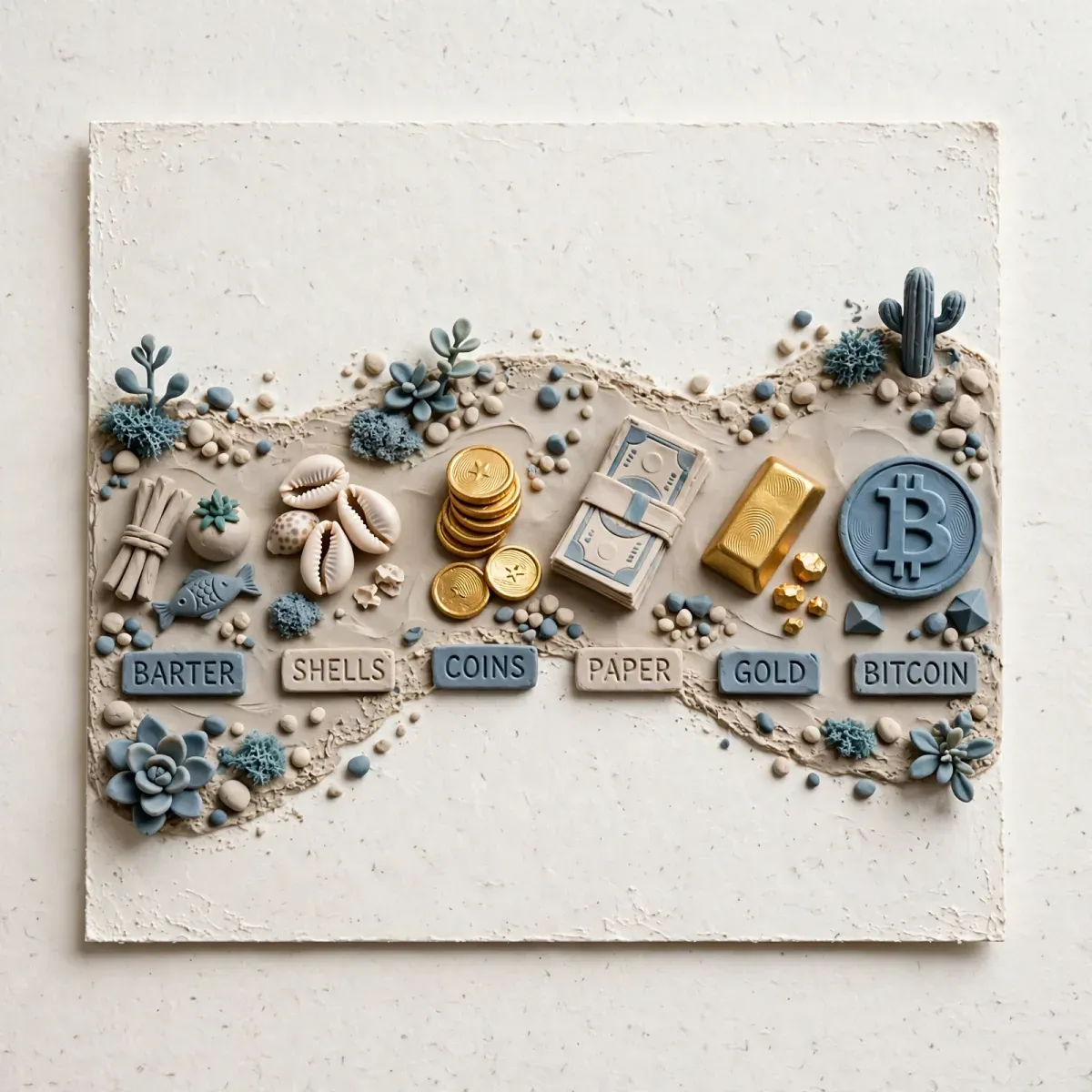
The chronology of evolution - 5 eras
Era 1: Commodity money (3000 BCE - 600 BCE) Kauri shells in China and Africa, salt in Rome (hence “salary”), cattle, grain. The problem: not uniform, it spoils, it is hard to transport. Even so it worked for thousands of years, because it was better than barter.
Era 2: Metal coinage (around 600 BCE - 1661) The first struck coins in Lydia (modern-day Turkey) around 600 BCE, made of an alloy of gold and silver - electrum. Only a coin allowed standardisation. Weight and purity were guaranteed by the ruler’s stamp. The Roman denarius, the Greek drachma - these were the first global currencies. The problem: clipping and debasement - rulers mixed in cheaper metals.
Era 3: Paper and bank money (1661 - 1971) 1661 - Stockholms Banco issues the first banknotes in Europe. A banknote is a bill of exchange - a promise to pay out metal on demand. If you trust the issuer, you do not have to carry gold. That radically increased the velocity of circulation. In 1717 Isaac Newton, as Master of the Mint, set the price of gold, which created a de facto gold standard in England.
Era 4: Fiduciary money - fiat (1971 - 2009) Since 15 August 1971, when Richard Nixon closed the gold window, money has had no commodity backing. Its value rests solely on trust in the state and its ability to collect taxes. This is the largest monetary experiment in history - it has been running for 50+ years.
Era 5: Cryptographic money (2009 - today) 3 January 2009, the Bitcoin genesis block. The first attempt to create money with no central issuer, in which a limited supply is guaranteed by mathematics, not by an institution. Does it meet the 6 properties? We will see in the table.
Comparing forms of money
| Form | Durability | Divisibility | Portability | Limited supply | Who controls it? |
|---|---|---|---|---|---|
| Gold | Very high | Medium (melting) | Low | Yes, physically | Nature + mining |
| Fiat banknote (PLN, USD) | Low (it wears out) | High | High | No, the central bank decides | Central bank |
| Bank entry (account) | Digital | Very high | Very high | No, the reserve system | Commercial banks + central bank |
| Bitcoin | Digital, network-dependent | Very high (8 decimal places) | Very high | Yes, 21 million | Protocol + consensus |
The formula for the value of money over time:
Real_Value = Nominal / (1 + Cumulative_Inflation)

Example: 1,000 PLN from 2015 with cumulative inflation of 45% (2015-2024):
Real_Value = 1000 / 1.45 = 689.65 PLN in 2015 purchasing power.

That is a 31% loss of purchasing power with no transaction at all.
That is why a trader has to measure results in real terms, not nominal terms.
What does this mean for the market?
Every change in the form of money changed the structure of the market. The shift to paper money made the creation of exchanges possible. The shift to fiat made it possible to leverage the credit system to levels unimaginable under the gold standard. The shift to electronic records made high-frequency trading possible.
When you understand that the PLN in your account is not “money” but a liability of a commercial bank, that the cash in your wallet is a liability of the NBP (Narodowy Bank Polski, the Polish central bank), and that a bank’s reserves at the NBP are central bank money - you begin to understand why the system has layers and why in a crisis those layers matter.
When the plan says: do not trade
- When you do not know what you are trading. If you open a position on XAU/USD without understanding the difference between physical gold, a futures contract and a gold ETF, and what settlement means - you are not trading, you are guessing.
- When you confuse money with wealth. A rising PLN balance with inflation at 15% year on year is not a profit. If you do not calculate the real result, your plan is blind to the most important risk.
- When the “this time it is different” narrative dominates the headlines. In every era, supporters of a new form of money claimed the old rules no longer applied. History has always verified that painfully.
The mistakes that cost the most
Mistake 1: Treating fiat money as a durable store of value with no cost. Cash in a non-interest-bearing account loses purchasing power every day. It is not a “safe haven”. It is a guaranteed, slow loss by definition of the inflation-targeting system of the NBP at 2.5%.
Mistake 2: Not understanding counterparty risk in bank money. A deposit in a bank is not your money in a vault. It is a loan to the bank. Up to EUR 100,000 is protected by the BFG (Bankowy Fundusz Gwarancyjny, the Polish bank guarantee fund); above that you are a creditor. In Cyprus in 2013, deposits above 100k were partially confiscated (bail-in).
Mistake 3: Confusing price with value and supply with demand. Many beginners think Bitcoin rises because “people are buying”. Yes, but the question is: what is the liquidity, what is the depth of the order book, what is the cost of mining, what is the flow onto exchanges. Without measuring supply and demand on-chain, it is guessing.
A measurable exercise
Goal: Calculate the real loss of purchasing power of your capital.
Steps:
- Take the cash balance you held in a savings account / ROR (the Polish personal current account) 3 years ago. For example 10,000 PLN on 1 January 2022.
- Download the GUS (Statistics Poland) data on annual CPI inflation: 2022: 14.4%, 2023: 11.4%, 2024: 3.6% (sample data, get the current figures).
- Calculate the cumulative inflation:
Cumulative_Inflation = (1+0.144)*(1+0.114)*(1+0.036) - 1 = 0.319 = 31.9%
Real_value_2025 = 10000 / 1.319 = 7581 PLN at 2022 prices
Cost_of_holding_cash = 10000 - 7581 = 2419 PLN- Calculate how much you would have to earn from trading (after the 19% tax on profits, the Belka tax) just to match inflation.
Write the result in your journal. This is your “zero” benchmark. Any trading system below that result loses in real terms.
Test yourself
- Why is barter inefficient in a large economy? Explain the concept of the double coincidence of wants and the formula for the number of exchange pairs.
- List the 6 properties of good money and rate PLN and Bitcoin on a scale of 1-5 for each property.
- What does it mean that modern money is fiduciary? What does its value rest on since 1971?
- Calculate the real value of 5,000 PLN from 2020 with cumulative inflation of 35%. How large is the loss of purchasing power?
- Explain the difference between central bank money and commercial bank money. Which one do you use every day?
Frequently asked questions
Is a return to the gold standard possible? Technically yes, politically and economically extremely difficult. It would require limiting the money supply to gold reserves, which means a brutal deflation of debt. Indebted economies cannot afford that without a deep crisis. That is why for 50 years no large country has returned to it.
Is Bitcoin money or a commodity? It depends on the legal definition and the function. Today, in most jurisdictions, including Poland, it is treated as a property right / a digital commodity. As a means of payment it is used marginally, because of volatility and fees. As a hedge against inflation - a narrative, but without the long history that gold has.
Why did shells and salt stop being money? Because they failed the limited supply test. When Europeans brought kauri shells to Africa in bulk, shell hyperinflation followed. When the technology of salt extraction became cheap, salt lost its value. Any commodity money that can be easily multiplied collapses.
Will cash disappear? In Sweden the share of cash in transactions has fallen below 10%. In Poland cash is still around 35% of transactions, but it is falling. Governments promote cashless payments (a smaller shadow economy, more control). Cash will not disappear legally any time soon, but its economic importance is shrinking. For a trader what matters is this: the disappearance of cash means full digitalisation and traceability of flows.
Advertisement
Key takeaways
- Money is not an object, it is a technology. A technology for measuring value, carrying it through time and settling obligations. Every trader who does not understand the evolution of money does not understand the market they trade. This lesson reconstructs 5,000 years of experiments - from...
Structure sources
The material is based on source documents. Variable values — fees, limits, regulatory figures — are worth checking at the source before making a decision.
- Central banks — publications from the Fed, the ECB and the NBP (Narodowy Bank Polski) — nbp.pl
- BIS — annual economic reports
Disclaimer
- Educational material. Not investment advice or a recommendation. Trading involves the risk of losing capital.
- The materials are educational. They are not investment advice or a recommendation within the meaning of financial instruments trading regulations. Numbers in examples are illustrative unless a measurement date and source are given.
Who writes this and how we check it
The materials are written and verified by Redakcja Kurs Tradera — the rules are described on about the site: every number has a source, and we show gaps openly. Report a factual error via contact — corrections are described in the content.
Progress is stored only in this browser (localStorage) — there is no account and no copy on the server. Clearing site data will remove it. Manage your data