Module 1 / 2
The gold standard, Bretton Woods, and the collapse
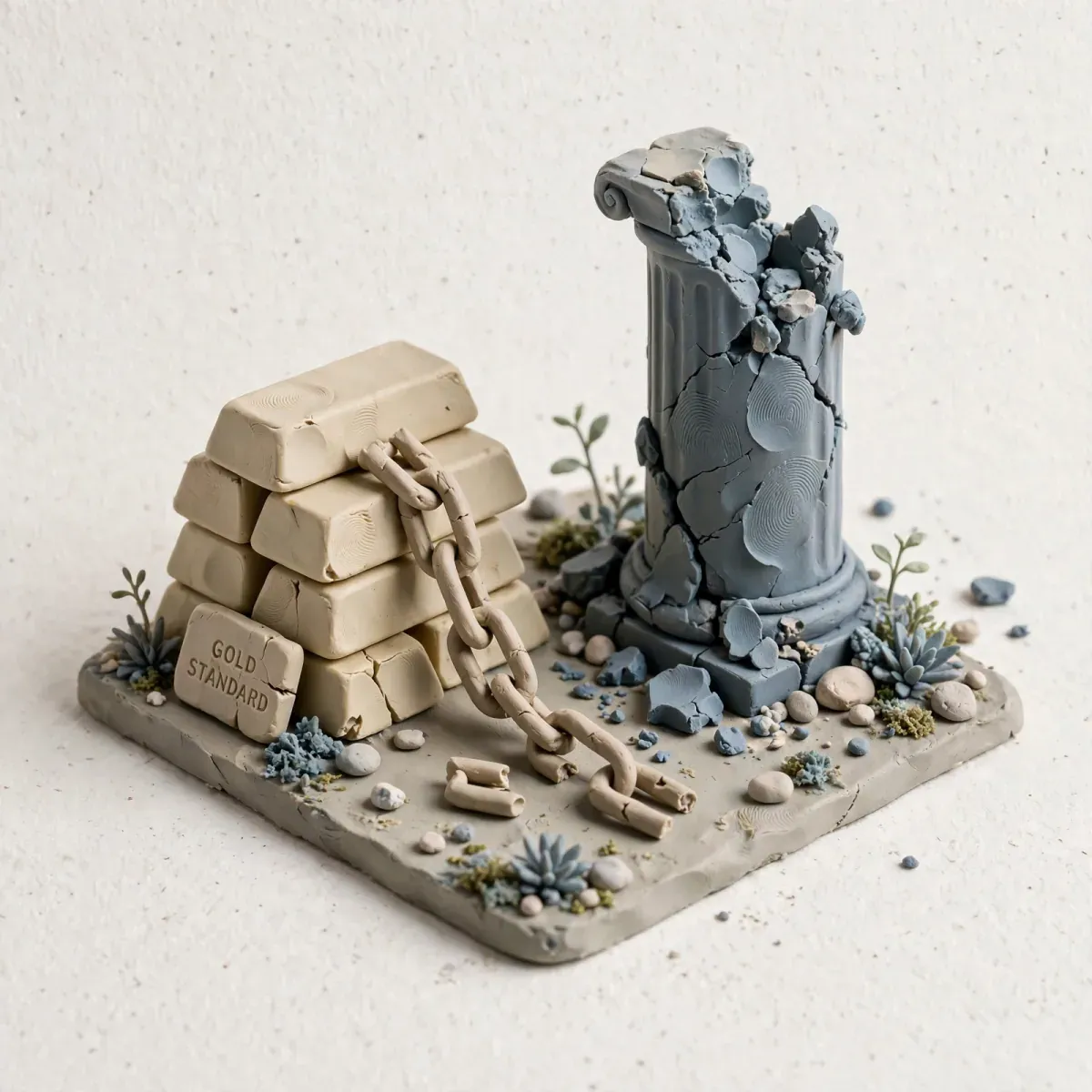
If lesson 01 was about WHAT money is, this lesson is about HOW people tried to tame it. The gold standard and the Bretton Woods system were the two biggest attempts to impose discipline on the monetary system. Both collapsed for the same reason: politicians needed to spend...
- Author
- Zordon Intelligence Sp. z o.o.
- Updated
- 8 min read
- Structure sources
- 2
If lesson 01 was about WHAT money is, this lesson is about HOW people tried to tame it. The gold standard and the Bretton Woods system were the two biggest attempts to impose discipline on the monetary system. Both collapsed for the same reason: politicians needed to spend more than the discipline of gold allowed them.
The classical gold standard (1870-1914)
The rule was simple and brutal. Every currency had a defined gold content. One British pound = 7.32 g of gold. One dollar = 1.5 g of gold. The central bank was obliged to exchange banknotes for gold at a fixed rate on demand. The money supply was limited by physical reserves.
How did it work in practice?
- If a country ran a trade deficit, gold flowed abroad.
- Less gold in the vaults = less money in circulation = falling prices (deflation).
- Cheaper goods from that country = rising exports = gold comes back.
- An automatic balancing mechanism, described by David Hume in the 18th century as the price-specie flow mechanism.
It was not a system without flaws. It was procyclical: in a recession gold flowed out, the central bank had to raise rates and shrink the money supply, deepening the recession. But it was predictable.
| Period | Average annual inflation, UK | Average annual inflation, USA | Notes |
|---|---|---|---|
| 1870-1914 | 0.2% | 0.1% | High growth, low inflation |
| 1914-1920 | 12.5% | 14.5% | Suspension of the standard, war financing |
| 1925-1931 | -0.5% | -1.2% | Attempted return, the Great Depression |
When World War I broke out, every country suspended convertibility. You cannot fight total war and keep the discipline of gold. Governments printed to buy cannons.
The interwar years and chaos (1918-1944)
The attempt to return to gold after the war was a catastrophe. Great Britain went back in 1925 at the pre-war rate, even though its economy was far weaker: the pound was overvalued by about 10%. The result: deflation, unemployment, the general strike of 1926. Churchill, the Chancellor of the Exchequer, later called it the biggest mistake of his life.
The United States and France, by contrast, were undervalued and sucked in the world’s gold. By 1930, 60% of the world’s gold reserves sat in those two countries. The system locked up. In 1931 the UK abandoned gold, then more countries followed. In 1933 Roosevelt confiscated the gold of US citizens (Executive Order 6102) and devalued the dollar from 20.67 USD/oz to 35 USD/oz - a 69% devaluation against gold.
Competitive devaluation was the trade weapon of the 1930s. Everyone pushed down the value of their currency to export unemployment to their neighbours.
Bretton Woods (1944-1971)
In July 1944, when the outcome of World War II was already decided, 730 delegates from 44 countries met at the Mount Washington Hotel in Bretton Woods, New Hampshire. The goal: to build a system that would not repeat the chaos of the 1930s, but would allow reconstruction.
The architects: Harry Dexter White (USA) and John Maynard Keynes (UK). White’s plan won.
The rules of the Bretton Woods system:
- The US dollar was convertible into gold at 35 USD per ounce, for central banks only.
- The other currencies had a fixed rate against the dollar with a narrow fluctuation band of +-1%.
- The IMF and the World Bank were created as guardians of the system.
- Controls on capital flows were permitted and recommended.
Why the dollar? Because in 1945 the USA held 70% of the world’s gold reserves (about 20 000 tonnes). The world needed dollars to trade, the USA needed to export dollars.
The system worked as long as the USA ran a trade and budget surplus. In the 1950s that was true. In the 1960s it no longer was - the Vietnam War and Johnson’s Great Society programme had a price.
The Triffin dilemma and the end
In 1960 the economist Robert Triffin described the paradox: for the world to have liquidity (dollars to trade with), the USA had to run a balance-of-payments deficit and export dollars. But the more dollars held abroad, the smaller the gold coverage and the weaker the trust in the 35 USD/oz promise. The system is condemned to lose confidence.
The numbers:
1945: US gold reserves 20 000 tonnes, dollars held abroad ~ 5 bn USD
1960: US gold reserves 17 500 tonnes, dollars held abroad ~ 20 bn USD, coverage 55%
1971: US gold reserves 8 100 tonnes, dollars held abroad ~ 60 bn USD, coverage 22%
France under de Gaulle understood the game and began systematically exchanging dollars for gold, sending warships to collect the metal. The UK had a permanent sterling crisis.
On 15 August 1971 Nixon, in a televised address (with no consultation with his allies), announced a “temporary” suspension of the dollar’s convertibility into gold. The temporary measure lasts to this day. It is called the Nixon Shock.
The rescue attempt - the Smithsonian Agreement of December 1971 - devalued the dollar to 38 USD/oz and widened the fluctuation band to 2.25%. The market did not believe it. In March 1973 the fixed-rate system collapsed. The era of floating exchange rates began.
What does this mean for a trader?
Understanding Bretton Woods explains three things:
- Why the dollar is the world’s reserve currency - because it inherited that role from a system in which it was the only currency convertible into gold. That status gives the USA the exorbitant privilege - it can print the currency the world needs.
- Why gold jumped from 35 USD in 1971 to 850 USD in 1980 - because for 20 years the price had been artificially suppressed. When the spring was released, a repricing followed.
- Why the fiat system is built on debt - without an anchor in gold, there is no limit to credit creation. Since 1971 global debt has risen from ~100% of GDP to >300% of world GDP.
| Indicator | 1971 (end of BW) | 2024 (estimate) |
|---|---|---|
| Gold price | 35 USD/oz | ~2300 USD/oz |
| US debt / GDP | 37% | 123% |
| Fed balance sheet | 88 bn USD | 7700 bn USD |
| USD as % of world reserves | 71% | 58% |
When the plan says: do not trade
- When a central bank changes the rules of the game over the weekend. Nixon closed the gold window on a Sunday evening. The Swiss National Bank abandoned the EUR/CHF peg on 15 January 2015 without warning. If you hold a leveraged position over the weekend in a pegged currency, you are asking for a 20% gap.
- When the narrative about a “return to gold” drives FOMO. The myth comes back every few years. Politically it is impossible without a deflationary crash. Do not trade that thesis without a hard plan and an understanding of the mechanics.
- When you do not understand the exchange-rate regime of the instrument. Trading USD/HKD (pegged to the USD), trading the franc before 2015 (pegged to the EUR), trading a stablecoin pretending to be worth 1 USD - all of it is trading a promise to hold a rate. If the promise breaks, the stop-loss will not save you.
The mistakes that cost the most
Mistake 1: Believing that a fixed rate means no risk. A fixed rate accumulates pressure like a dam. The longer it lasts, the more energy there is to release. Carry traders in the Turkish lira before 2018 or in the franc before 2015 learned this through margin calls.
Mistake 2: Ignoring the central bank balance sheet as an indicator. When the Fed grew its balance sheet from 900 bn in 2008 to 4500 bn in 2015, that was not “money printing”. It was an asset swap (bonds for reserves). But it did increase liquidity and fuelled a bull market in assets. If you do not track M0 and the Fed/ECB balance sheet, you do not understand the fuel for the market.
Mistake 3: Believing in the immortality of a reserve currency. The pound was a reserve currency for 100 years before the dollar. In 1890, 60% of the world’s reserves were in pounds. By 1930, only 30%. Reserve status is not granted forever: it changes slowly, and then suddenly. Currency diversification is not a whim, it is history.
A measurable exercise
Goal: To understand devaluation through gold.
Steps:
- Download the historical price of gold in USD and PLN since 1971.
- Calculate how many ounces of gold 1 million USD bought in 1971 and buys today:
1971: 1 000 000 / 35 = 28 571 oz
2024: 1 000 000 / 2300 = 435 oz
Loss of purchasing power vs gold: (28571-435)/28571 = 98.5%- The same for PLN. In 1995, after the redenomination of the zloty, 1 million PLN was about 10 000 USD. How much gold did it buy then, and how much does it buy today?
- Write down the conclusion: what does a 98.5% loss against gold mean for long-term storage of value in fiat?
The point of the exercise is not admiration of gold, but measurement of the cost of a system without an anchor.
Test yourself
- Explain the price-specie flow mechanism. How did an outflow of gold automatically correct a trade deficit under the classical gold standard?
- What was the Triffin dilemma? Why was it unsolvable inside Bretton Woods?
- What happened on 15 August 1971, and why do we call it the Nixon Shock?
- Compare inflation in 1870-1914 with 1971-2024. What does the difference tell you about monetary discipline?
- Why did de Gaulle send warships for gold? What game was he playing inside Bretton Woods?
Frequently asked questions
Was the gold standard better? It had lower average inflation, but greater short-term volatility and more frequent banking panics. It did not allow active monetary policy in a recession. For a saver - better. For an indebted state and a system full of debt - unsustainable.
Does Bretton Woods II exist? Some economists talk about an informal system in which Asia (China) keeps an unofficial peg to the USD to support exports, much as Europe did in the 1960s. But without formal convertibility into gold and without the IMF as the enforcer. It is a loose analogy.
Why did the USA not go bankrupt even though it lost its coverage? Because US debt is in a currency the USA issues itself. It can always create more dollars to pay the debt nominally. The question is: how much will those dollars be worth? The risk is inflation and devaluation, not nominal bankruptcy.
Was the 35 USD/oz rate a market rate? No, it was administrative and set below the market. As early as 1968 a two-tier gold market emerged - an official 35 USD rate for central banks and a free-market one in London, where the price was higher. That was a signal that the system was cracking.
Advertisement
Key takeaways
- If lesson 01 was about WHAT money is, this lesson is about HOW people tried to tame it. The gold standard and the Bretton Woods system were the two biggest attempts to impose discipline on the monetary system. Both collapsed for the same reason: politicians needed to spend...
Structure sources
The material is based on source documents. Variable values — fees, limits, regulatory figures — are worth checking at the source before making a decision.
- Central banks — publications of the Fed, the ECB and NBP (National Bank of Poland) — nbp.pl
- BIS — annual economic reports
Disclaimer
- Educational material. Not investment advice or a recommendation. Trading involves the risk of losing capital.
- The materials are educational. They are not investment advice or a recommendation within the meaning of financial instruments trading regulations. Numbers in examples are illustrative unless a measurement date and source are given.
Who writes this and how we check it
The materials are written and verified by Redakcja Kurs Tradera — the rules are described on about the site: every number has a source, and we show gaps openly. Report a factual error via contact — corrections are described in the content.
Progress is stored only in this browser (localStorage) — there is no account and no copy on the server. Clearing site data will remove it. Manage your data