Module 2 / 2
Inflation, deflation and stagflation - examples from Poland
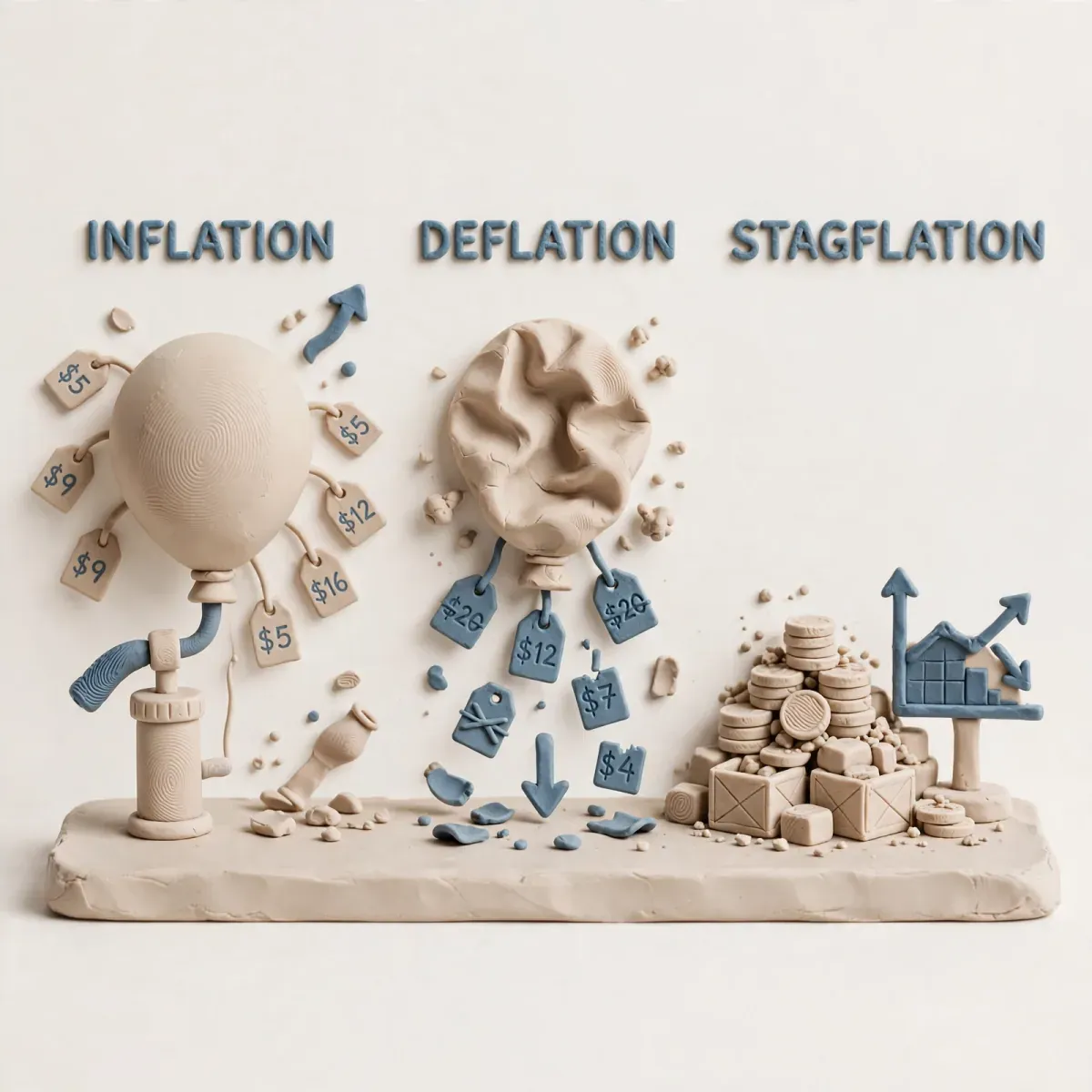
Inflation is not "high prices". It is a measure of how fast money loses purchasing power. Deflation is not "cheapness", only a rise in purchasing power, often alongside falling activity. Stagflation is the worst scenario for a trader and a consumer: prices rise while the economy does not. Poland has lived through...
- Author
- Zordon Intelligence Sp. z o.o.
- Updated
- 7 min read
- Structure sources
- 2
Inflation is not “high prices”. It is a measure of how fast money loses purchasing power. Deflation is not “cheapness”, only a rise in purchasing power, often alongside falling activity. Stagflation is the worst scenario for a trader and a consumer: prices rise while the economy does not. Poland has lived through all three within 35 years. That is a laboratory better than a textbook.
Operational definitions
Inflation: A rise in the general price level. We measure it with the CPI (Consumer Price Index) - a basket of around 1,400 goods and services weighted by their share of spending.
Inflation_y/y = (CPI_t / CPI_t-12 - 1) * 100%

PL example: CPI December 2022 = 114.4 (with December 2021 = 100) → inflation 14.4%
The NBP (Narodowy Bank Polski, Poland’s central bank) target: 2.5% +/-1pp. Above 3.5% the Monetary Policy Council (RPP) should tighten. Below 1.5% it should loosen.
Deflation: A fall in the general price level lasting at least a few months. In Poland: from July 2014 to October 2016 we had CPI deflation from -0.2% to -1.1%. The reasons: cheap oil, cheap food, no wage pressure.
Stagflation: Inflation + stagnation (zero or slow growth) + high unemployment. The classics: Poland 1980-1982, the USA 1974-1980.
Disinflation: A fall in the inflation rate, but still positive. For example from 18.4% in February 2023 to 6.2% in November 2023 - that is disinflation, not deflation. Prices are still rising, just more slowly.
Poland - 3 episodes, 3 lessons
Episode 1: Hyperinflation 1989-1990
Poland 1989: inflation of 251% a year, and in 1990 after prices were freed - 585%. Empty money, an inflationary overhang (no goods, plenty of money). Balcerowicz: shock therapy - raising rates to 40%, scrapping subsidies, freeing the exchange rate.
The lesson: when there is too much money relative to goods, prices explode. Without anchoring inflation expectations (rates high and positive in real terms) the spiral winds itself up. People spend immediately, because tomorrow will be more expensive - V rises in the equation MV=PQ.
Episode 2: Deflation 2014-2016
CPI was negative for 26 months. Was it bad? Not for the consumer - cheap fuel, cheap credit. But for a trader it is a signal: demand is weak, companies cannot raise prices, margins are under pressure. The WIG (the Warsaw Stock Exchange index) did not rise despite the NBP’s zero rates (1.5%). The ECB (EBC) ran QE, because it feared deflation like the devil fears holy water - because deflation raises the real value of debt.
The formula for the real interest rate:
real_rate = nominal_rate - expected_inflation

2015: WIBOR 1.7% - deflation -0.5% = a positive real rate of 2.2%, despite "low" rates.
2022: WIBOR 7% - inflation 14% = a negative real rate of -7%, despite "high" rates.
A trader looks at the real rate, not the nominal one.
Episode 3: The return of inflation 2021-2023
A perfect example of inflation driven by both supply and demand:
- Supply: COVID broke supply chains, sea freight went up 10x, energy +300% after the war in Ukraine.
- Demand: anti-COVID relief packages (PIT 0, the 500+ child benefit, top-ups), pent-up demand, 2% loans during the pandemic.
- Expectations: companies began raising prices pre-emptively.
The result: CPI of 18.4% in February 2023 - the highest since 1996. The NBP was late: it started raising rates in October 2021, from 0.1% to 6.75% by September 2022. The ECB was later still.
| Year | CPI avg PL | WIBOR 3M avg | Real rate | WIG20 |
|---|---|---|---|---|
| 2020 | 3.4% | 0.6% | -2.8% | -7.7% |
| 2021 | 5.1% | 0.8% | -4.3% | 20% (pumped by liquidity) |
| 2022 | 14.4% | 6.0% | -8.4% | -21% (tightening) |
| 2023 | 11.4% | 6.0% | -5.4% | +23% (disinflation) |
Stagflation - why is it a nightmare?
In ordinary inflation the central bank raises rates, the economy slows, inflation falls. In stagflation you have inflation for supply-side reasons (oil, war), and raising rates kills growth without solving the supply problem.
Poland 1980-82: ration coupons, 100% inflation, GDP down 10%. The USA in the 1970s: on top of that came the wage-price spiral - trade unions indexed wages to CPI.
For a trader, stagflation means:
Stocks: fall, because margins = P - costs, and costs rise faster than P
Bonds: fall, because nominal rates rise
Cash: loses, because of inflation
Gold/commodities: rise, because they are the source of the inflation
So 60/40 (stocks/bonds) does not work - 2022 was the best example.
How to measure inflation yourself
Do not trust the headline CPI alone. Measure the baskets that matter to you as a trader:
- Core inflation (core CPI): CPI without food and energy. In Poland in 2023 core was 10% while headline was 11.4% - it showed stickiness.
- PPI (Producer Price Index): producer prices. It leads CPI by 3-6 months. If PPI rises 20%, CPI will follow.
- Inflation expectations: NBP surveys, the 5y5y inflation swap. If expectations are anchored at 3.5% despite a 2.5% target, the RPP has a credibility problem.
- Your own trader basket: Work out what a month of life as a trader costs you: subscriptions, data, commissions, electricity, hardware. If that grows 15% a year, your breakeven grows 15% too.
trading_breakeven = fixed_monthly_costs / average_profit_per_trade
If costs rise 15% and the edge stays the same, you must take more trades or improve the edge by 15%.
When the plan says: do not trade
- When CPI surprises by 1pp+ versus the forecast 10 minutes after the release. Algorithms reprice in milliseconds. Your market order will get 50 pips of slippage. Wait 15 minutes for things to settle and read the breakdown.
- When you have stagflation and you try to play buy-the-dip on indices. In stagflation the bottom comes later and is deeper. Company margins fall quarter after quarter. Better to wait for the inflation pivot than to catch a falling knife.
- When your strategy does not account for inflation in the backtest. A strategy from 2015-2020 tested on zero rates and deflation will not work in 2022-2023. You have to test across different inflation regimes.
The mistakes that cost the most
Mistake 1: Using nominal returns to judge success. You made 20% in 2022, inflation was 14.4%, tax 19% (the Belka tax, Poland’s capital-gains tax), commissions 1% = in real terms 20*0.81 -14.4 -1 = 0.8%. You are at zero. If you do not calculate in real terms after tax and costs, you are fooling yourself.
Mistake 2: Thinking that deflation is always a buying opportunity. Debt deflation (Fisher’s debt deflation) - prices fall, but the nominal value of the debt stays the same, so in real terms it grows. Companies go bankrupt even though goods are cheap. In Japan from 1990 to 2012 the Nikkei fell 80% despite deflation - because corporate earnings deflated as well.
Mistake 3: Assuming the NBP always beats inflation quickly. Inflation after a supply shock is sticky. Service prices in Poland were still rising 6% in 2024 despite falling energy, because wages were catching up. The NBP targets 2.5%, but the return from 18% to 2.5% took three years and cost the economy.
A measurable exercise
Goal: Calculate your real rate of return.
Steps:
- Take your trading result for 2023: for example +15,000 PLN gross.
- Subtract commissions and costs: 15,000 - 2,000 = 13,000.
- Tax: 13,000 * 0.19 = 2,470. That leaves 10,530 net.
- Starting capital: 100,000. Nominal net return: 10.53%.
- Average CPI inflation 2023: 11.4%.
real_return = (1 + nominal_net)/(1 + inflation) - 1
real = 1.1053/1.114 - 1 = -0.78%
You are under water in real terms despite a nominal profit. Write that down. It changes the perspective on “how much I really have to earn”.
- Repeat for 2020, 2021, 2022 and 2024. Draw a real-versus-nominal chart.
Check yourself
- Explain the difference between inflation, disinflation and deflation using Polish CPI for 2022-2024.
- Calculate the real interest rate: WIRON 5.5% nominal, expected inflation 4%. What is the real rate? Is that tightening or easing?
- Why is stagflation worse for a 60/40 portfolio than inflation alone or a recession alone?
- Name 2 indicators that lead CPI inflation and explain the lag.
- Calculate the real return: +20% gross, -2% costs, -19% tax, 10% inflation. What is the real figure?
Frequently asked questions
Is the NBP’s 2.5% inflation target good? In the view of central banks, yes - it provides a buffer against deflation and greases the gears (wages can rise nominally without real cuts). For a saver - that is a 22% loss of value over 10 years. That is why saving in cash does not build wealth.
Why did deflation in 2015 not cause a crisis? Because it was imported (cheap oil) and short-lived, and expectations stayed anchored. The economy grew 3.5%. The dangerous kind of deflation is the demand-driven one - when people postpone purchases because it will be cheaper - and then the spiral runs downward.
Can you make money from inflation? You can avoid losing and hedge. The instruments: inflation-linked bonds (COI, EDO in Poland), commodities, companies with pricing power (they can pass costs on). But each one carries its own risk. The most important thing for a trader: do not hold cash long-term in an inflationary environment.
What is core inflation and why does it matter more to the RPP? Because it strips out the noise of food and energy, which monetary policy cannot influence in the short term. If core is 6%, it means inflation has worked its way into services and wages - it is sticky and requires higher rates for longer.
Advertisement
Key takeaways
- Inflation is not "high prices". It is a measure of how fast money loses purchasing power. Deflation is not "cheapness", only a rise in purchasing power, often alongside falling activity. Stagflation is the worst scenario for a trader and a consumer: prices rise while the economy does not. Poland has lived through...
Structure sources
The material is based on source documents. Variable values — fees, limits, regulatory figures — are worth checking at the source before making a decision.
- Central banks — publications by the Fed, the ECB (EBC) and the NBP — nbp.pl
- BIS — annual economic reports
Disclaimer
- Educational material. Not investment advice or a recommendation. Trading involves the risk of losing capital.
- The materials are educational. They are not investment advice or a recommendation within the meaning of financial instruments trading regulations. Numbers in examples are illustrative unless a measurement date and source are given.
Who writes this and how we check it
The materials are written and verified by Redakcja Kurs Tradera — the rules are described on about the site: every number has a source, and we show gaps openly. Report a factual error via contact — corrections are described in the content.
Progress is stored only in this browser (localStorage) — there is no account and no copy on the server. Clearing site data will remove it. Manage your data