Module 2 / 2
The future of money - CBDC vs Bitcoin vs gold
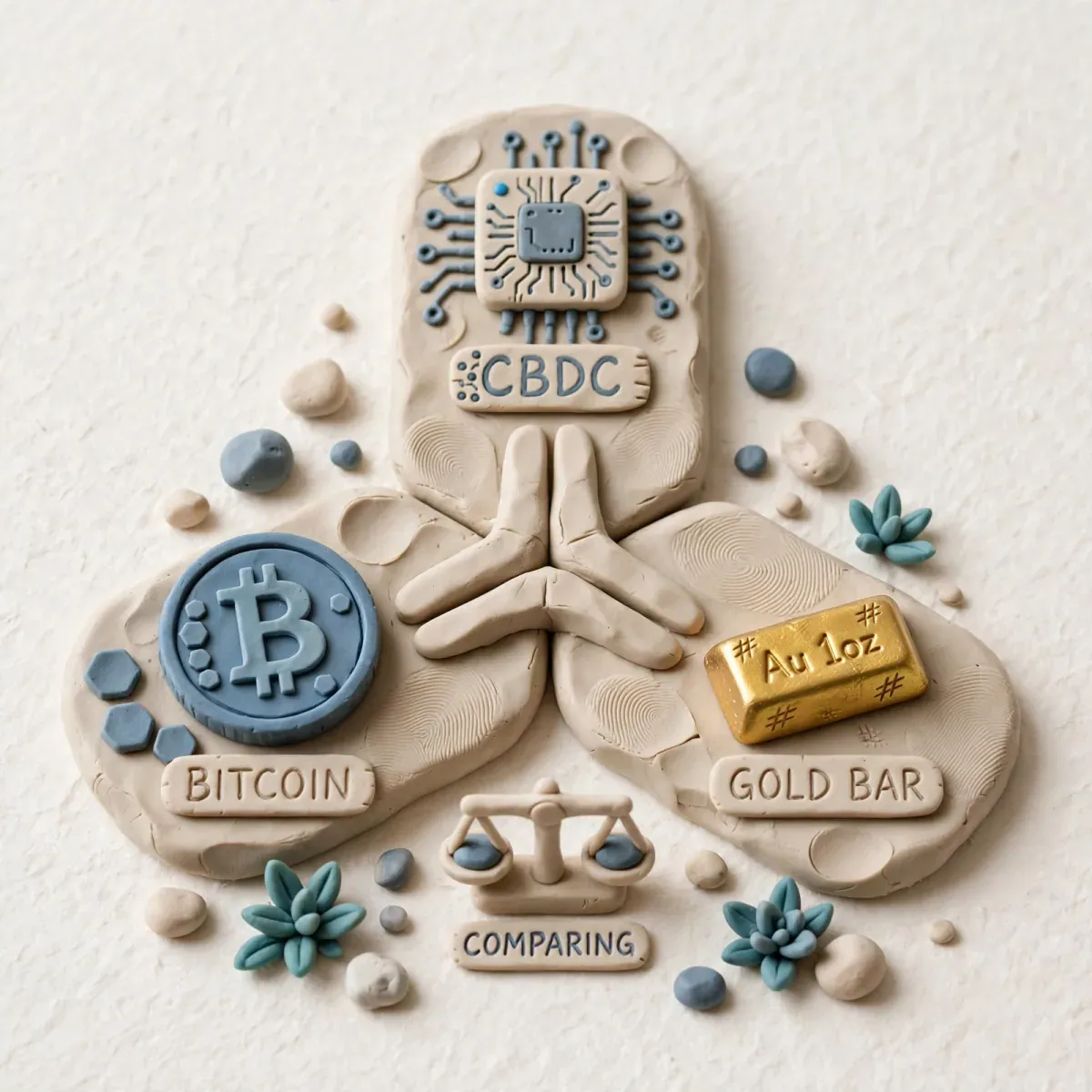
The dispute about the future of money is a dispute about trust: do you trust the state, mathematics, or metal? Each of the three candidates - CBDC (central bank digital currency), Bitcoin and gold - offers a different answer to the same question: how to preserve value and settle transactions when...
- Author
- Zordon Intelligence Sp. z o.o.
- Updated
- 8 min read
- Structure sources
- 2
The dispute about the future of money is a dispute about trust: do you trust the state, mathematics, or metal? Each of the three candidates - CBDC (central bank digital currency), Bitcoin and gold - offers a different answer to the same question: how to preserve value and settle transactions when a system built on debt starts to creak. Your job as a trader is not to choose a faith, but to understand the mechanics and the risks of each one.
CBDC - cash 2.0 with supervision
CBDC (Central Bank Digital Currency) is a direct liability of the central bank, but in digital rather than paper form. Do not confuse it with commercial bank money (a deposit) or with an electronic payment (Blik is a transfer of a deposit, not CBDC).
Models:
| CBDC model | Who holds the account? | Anonymity | Example |
|---|---|---|---|
| Direct retail | The citizen holds an account at the central bank | Low, full KYC | e-CNY pilot in China |
| Indirect retail | Banks distribute it, but the liability is the central bank’s | Medium | Considered by the ECB |
| Wholesale | Banks and institutions only | None for the citizen | Project mBridge |
What does CBDC promise?
- Instant 24/7 settlement, with no commercial bank risk.
- The option of negative rates applied directly to your account (you cannot escape into cash if cash is abolished).
- Programmable money - for example a benefit valid only for food for 30 days.
What does it risk?
- Full surveillance of every transaction. China is already testing a social score tied to e-CNY.
- A run on the banks: if people move deposits out of commercial banks into CBDC (the safer option), the fractional reserve system collapses. That is why the ECB talks about a limit of EUR 3,000 per person.
- Digital exclusion and system outages.
Status in 2024: 130 countries are researching it, 11 have fully implemented it (mainly the Caribbean, Nigeria’s eNaira - an adoption failure below <1%), China has a pilot in 26 cities. In the EU, the digital euro is in its preparation phase 2023-2025, with a decision after 2026.
Bitcoin - money without a state, but with energy
Bitcoin is not a “currency”. It is an accounting protocol with a limited supply:
Max_supply = 21,000,000 BTC
Current_supply ~ 19.7 million (2024)
Supply inflation ~1.7% in 2024, falling every 4 years through the halving
Last BTC mined around the year 2140
Security rests on Proof-of-Work - energy converted into network security. A 51% attack requires taking over >50% of the network’s computing power - a cost of billions of USD per day plus hardware.
Advantages from a trader’s perspective:
- Independence from the banking system, 24/7 global settlement in 10-60 minutes.
- A supply that cannot be manipulated politically. Unlike gold, you cannot discover a new mine and suddenly increase the supply by 10%.
- Perfect divisibility and portability.
Drawbacks:
- Volatility: -80% drawdowns three times in its history (2011, 2014, 2018, 2022). This is not a stable store of value over a 1-2 year horizon.
- Scalability: 7 transactions/s on layer 1. Visa: 65,000/s. The Lightning Network is trying to fix this, but adoption is low.
- Correlation: in the liquidity crises of 2020 and 2022, Bitcoin behaved like levered technology stocks, not like gold. In 2022 it fell -65% while gold returned +0%.
| Feature | Bitcoin | Gold | PLN cash |
|---|---|---|---|
| Limited supply | Yes, by algorithm | Yes, by physics | No |
| History as money | 15 years | 5,000 years | 100 years (the zloty) |
| Dependence on electricity/internet | 100% | 0% | Partial |
| Anonymity | Pseudonymity (a public chain) | High in physical form | Medium for cash, low for electronic |
| Cost of storage | Low (a seed) but the risk of losing the keys | High (a safe, insurance) | Low |
Gold - the analogue safe haven that does not know a password
Gold carries no counterparty risk, needs no electricity, and its supply grows slowly:
Annual mining ~3,000 tonnes, above-ground stock ~200,000 tonnes
Gold inflation = 3000/200000 = 1.5% per year - stable for 100 years
Why are central banks buying gold at record levels (2022-2023: 1,000+ tonnes per year, and the National Bank of Poland (NBP) bought 300 tonnes)? Because gold is the only reserve that is not a liability of another state. Dollars in reserves are a liability of the United States. Gold is no liability at all.
Gold does have costs, however: it pays no interest (an opportunity cost when rates are 5%), it has to be stored and insured, and its price in the short term depends on real interest rates.
An empirical formula:
Gold_price ~ 1 / Real_interest_rate

When real rates rise (the Fed hikes, inflation falls), gold falls - because holding gold costs money (you receive no interest).
When real rates fall/go negative, gold rises.
In 2022 real rates went from -5% to +2% - gold should have fallen 20%, yet it fell only -5%, because central bank demand offset the move.
Future scenarios - not prophecies, just a matrix
| Scenario | CBDC | Bitcoin | Gold | What does the system do? |
|---|---|---|---|---|
| Soft status quo | CBDC as an add-on, with limits | A speculative asset, ETFs, 5% of portfolios | A central bank reserve | Low inflation of 2-3%, debt rolled over |
| Inflationary reset | Programmable CBDC, negative rates to force spending | Rises as a hedge, but stays volatile | +100% in 3 years | High inflation of 6-10%, debasement of debt |
| Deflationary crash | Accelerated rollout to save the transmission channel | -70% in a liquidity panic | Rises after an initial drop | Massive QE plus fiscal stimulus, like 2020 x2 |
| Geopolitical fragmentation | Two blocs: e-CNY vs the digital euro/USD | A neutral bridge between blocs (like gold once was) | A neutral reserve | Partial de-dollarisation |
No scenario eliminates the others. Most likely all three forms will coexist in different niches, just as cash, deposits and gold coexist today.
When the plan says: do not trade
- When the narrative “CBDC = the end of cash tomorrow” drives panic buying of gold or crypto. CBDC rollouts are a 5-10 year process, with social and legal resistance. Do not trade a tweet; trade a law that has been passed and implemented.
- When you buy Bitcoin because of its “limited supply” while leveraging 10x at an exchange that can go under. FTX collapsed in 2022 and clients lost 8 billion USD despite the “limited supply” of BTC. The protocol’s supply != the safety of an exchange. If you do not hold the keys, you do not hold the BTC.
- When you think gold always protects you in a crisis. In March 2020 gold fell -14% in 2 weeks, because funds sold liquid assets to cover margin calls. Protection works on a horizon of months, not hours. If you run a 5% stop on gold, you will be stopped out before the protection arrives.
The mistakes that cost the most
Mistake 1: All-in on one vision of the future. Going all-in on BTC because “fiat will die” ended 2022 with a -75% drawdown. All-in on cash because “Bitcoin is a scam” ended 2020 with -15% in real terms. Diversifying your ideas is the foundation. Positioning should reflect uncertainty, not certainty.
Mistake 2: Ignoring storage costs and taxes. Physical gold in Poland: a +5% spread when buying, -5% when selling, 23% VAT on silver (investment gold is exempt), plus storage. Bitcoin: a 19% tax on profit (PCC, the Polish civil-law transaction tax, and PIT, the personal income tax), exchange risk, on-chain fees of 20-50 USD in a bull market. CBDC: potential negative rates and programmability. Every form of money has a carrying cost.
Mistake 3: Confusing technology with an investment. Blockchain is a brilliant accounting technology. That does not mean every token on a blockchain has value. In 2017 there were 1,000 tokens; today 90% of them are worth <1% of their peak. The internet in 2000 looked the same - the technology survived, but Pets.com went bankrupt. A trader invests in adoption and cash flow, not in a whitepaper.
A measurable exercise
Goal: Build a barometer of the future of money.
Steps:
- Define 4 adoption indicators:
W1 = CBDC share in the pilot (e.g. e-CNY transactions / M0)
W2 = Bitcoin: number of addresses with >0.1 BTC * price / gold market capitalisation
W3 = Central bank gold purchases (tonnes per quarter, source WGC)
W4 = USD share of world reserves (IMF COFER)- Pull the data for the last 8 quarters.
- Calculate the trend: is W1 growing >10% quarter on quarter? Is W4 falling?
- Decide: if W4 falls <58% and W3 is >1000 t per year, then de-dollarisation is accelerating. How does that affect your positions in EUR/USD and in gold?
- Update it quarterly. This is not a trading signal, it is a map of the regime.
Test yourself
- Explain the difference between retail and wholesale CBDC, and why a EUR 3,000 limit on CBDC is meant to protect commercial banks?
- Calculate Bitcoin’s supply inflation: 6.25 BTC per block every 10 minutes → how many BTC per day? How many per year? As a percentage of the 19.7 million supply?
- Why do central banks buy gold even though it pays no interest? What does “an asset with no counterparty risk” mean?
- Describe a scenario in which a CBDC with a negative rate and programmability is introduced. What options for defence do you have as a citizen or a trader?
- Compare the cost of storing 100k PLN in physical gold, in BTC in a cold wallet and in cash at a bank over 5 years (include the spread, the fees, the risk and inflation).
Frequently asked questions
Will CBDC replace cash? In the plans of the ECB and Poland’s Monetary Policy Council (RPP) - no. Officially CBDC is meant to be complementary. But economically, if holding cash costs money (transport, security) while CBDC is free and instant, cash will be marginalised naturally. In Sweden that is already happening without any CBDC.
Can Bitcoin be banned? Technically the protocol cannot be banned globally. What can be banned is the on/off ramp - exchanges in a given country (China, 2021). That kills liquidity locally, but not the network. Regulatory risk is greatest for the price, not for its existence.
Is gold obsolete next to Bitcoin? Central banks, which have weapons, an army and intelligence services, buy gold, not Bitcoin (2024). 15 years vs 5,000 years of history. Most likely gold will remain a politically neutral reserve while Bitcoin becomes a technological option for part of the capital. They do not have to be mutually exclusive.
What does “programmable money” mean? It is money with conditions written in code: you can spend it only until date X, only on categories Y, only in region Z. For a government it is an ideal tool for targeted fiscal policy. For a citizen it is the end of the fungibility of money. 100 PLN from a benefit is not equal to 100 PLN from work if the two follow different rules.
Advertisement
Key takeaways
- The dispute about the future of money is a dispute about trust: do you trust the state, mathematics, or metal? Each of the three candidates - CBDC (central bank digital currency), Bitcoin and gold - offers a different answer to the same question: how to preserve value and settle transactions when...
Structure sources
The material is based on source documents. Variable values — fees, limits, regulatory figures — are worth checking at the source before making a decision.
- Central banks — publications from the Fed, the ECB and the National Bank of Poland (NBP) — nbp.pl
- BIS — annual economic reports
Disclaimer
- Educational material. Not investment advice or a recommendation. Trading involves the risk of losing capital.
- The materials are educational. They are not investment advice or a recommendation within the meaning of financial instruments trading regulations. Numbers in examples are illustrative unless a measurement date and source are given.
Who writes this and how we check it
The materials are written and verified by Redakcja Kurs Tradera — the rules are described on about the site: every number has a source, and we show gaps openly. Report a factual error via contact — corrections are described in the content.
Progress is stored only in this browser (localStorage) — there is no account and no copy on the server. Clearing site data will remove it. Manage your data