Module 2 / 2
1-minute scalping and orderflow - tape, bid/ask
Scalping is a game of micro-edges: reading who is aggressive, where the passive liquidity sits, and when aggression is being absorbed. Without the DOM,…
- Author
- Zordon Intelligence Sp. z o.o.
- Updated
- 5 min read
- Structure sources
- 2
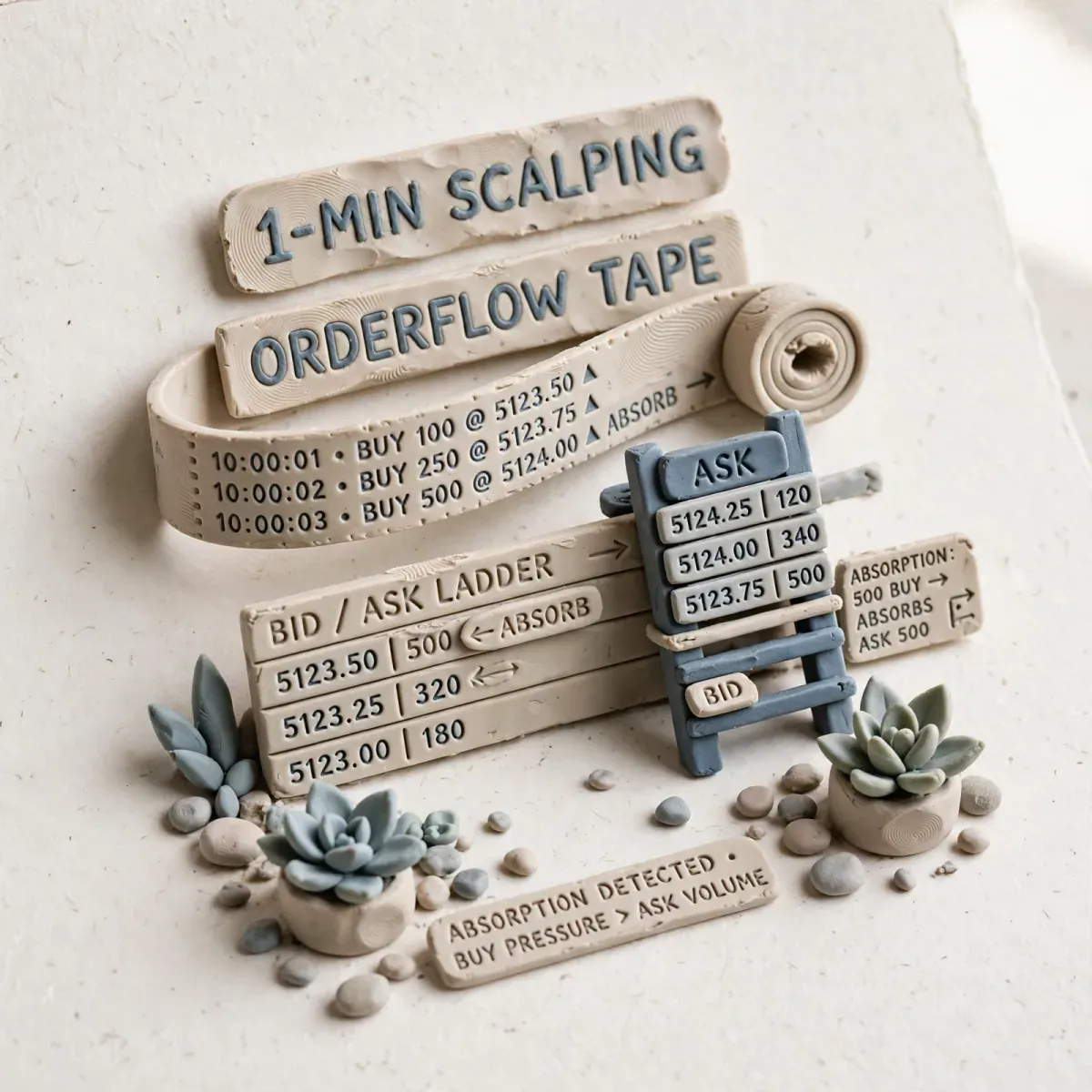
Scalping is a game of micro-edges: reading who is aggressive, where the passive liquidity sits, and when aggression is being absorbed. Without the DOM, Time & Sales and the bid/ask ladder you are scalping blind. This lesson teaches reading, not guessing direction.
Lesson goal
- Tell passive (limit) and aggressive (market) orders apart.
- Read Time & Sales and the M1 footprint for absorption and initiation.
- Define 2 measurable setups: absorption at a level + failed auction.
- Build hard execution rules with a tick-based loss limit.
Foundation
Passive = limit order in the book – provides liquidity, sits in the bid/ask
Aggressive = market order / marketable limit – takes liquidity, causes a transaction
Transaction = aggression hitting the passive side
Time & Sales shows the side of the aggression
DOM shows the passive liquidity that has not been eaten yet
Tools – what you must have on screen
- DOM / Ladder: bid/ask with volume. You look for large limits (iceberg, reloading).
- Time & Sales: the list of transactions. You read the pace and the size.
- Footprint 1-min: at each level you see how much volume traded on the bid versus the ask.
- Delta:
Delta = Vol_Aggressive_Buy - Vol_Aggressive_Sell
Two measurable scalping setups
Setup A: Absorption at a level
- Price reaches a known level (PD_H, PM_H, VWAP, OR_High).
- A large bid/ask in the DOM (e.g. 10x avg).
- In Time & Sales a series of large aggressive orders into the level, but price does not get through.
- Footprint: large volume, delta opposite to the move.
Entry: a limit at the absorption level after confirmation that price moves away 2-3 ticks. Stop 1 tick + spread behind the level. Target 1.5-2x the stop. Maximum time 90 sec.
Setup B: Failed Auction
- Price breaks a level (e.g. OR_H) on low aggressive volume.
- Delta weakens despite the break.
- A return to the middle in <60 sec and an M1 close back below/above the level.
Entry after the return to the middle. Stop behind the high/low of the false break. Target: the middle of the range or VWAP.
Orderflow signal table
| Observation | Meaning | Implication |
|---|---|---|
| Large limits in the DOM that vanish when price comes close | Spoof / liquidity withdrawal | Do not trade |
| Large limits that keep refilling (reload) | Genuine defence of the level | Look for absorption |
| Aggressive stack, rising delta, price not moving | Absorption on the opposite side | Potential reversal scalp |
| Small transactions, price moves fast | No resistance, initiation | Continuation, do not fade |
| Delta diverging from price | Aggression exhaustion | Prepare your exit |
Managing risk in scalping
Risk_ticks = 4-8 ticks max per scalp
Size = Risk_PLN / (Risk_ticks * Tick_value)
Max daily loss: 3 * Risk_PLN or 2% of the account
Time limit: 2 min max per position without progress
Rule of 3 losses: after 3 stops – a 15 min break
Footprint in practice – how to read a 1-min bar
At the 100 level you see:
- BidVol 1200 / AskVol 3500 -> aggressive buyers
- Next level 100.10 BidVol 4000 / AskVol 800 -> selling is absorbed at 100.10, but below it buyers step in. Interpretation: someone is defending 100.10 against further upside, but at 100 there is no supply left. That is a spot for a long scalp with a tight stop 2 ticks below.
Delta – the divergence that saves you
Example:
- Price makes a new OR high, Delta on the 1m bar = -800 (more aggressive selling than buying despite the high)
- Previous high Delta = +1500 Delta divergence = buy aggression is weakening despite the price. That is not a short signal in itself, but a ban on adding to longs and preparation for a failed auction.
The cost of overtrading in scalping – the maths
100 trades a day x spread 1 tick 5 USD = 500 USD cost a day
If avg win 15 USD and WR 55%, gross 100*0.55*15 - 100*0.45*10 = 825-450=375 USD
375 - 500 = -125 USD net per day
Conclusion: 100 trades must have a bigger avg win or WR >60% to cover the spread.
That is why filtering absorption is the key, not the number of clicks.
Orderflow psychology – 3 rules
- Wait for a large passive order – do not guess.
- After 2 failed absorptions – the level is eaten. Do not try to fade it a third time.
- If you do not understand what is happening in the DOM, you do not click. No understanding = no setup.
When the plan says DO NOT TRADE
- Spread > 2 ticks, the DOM empty – no liquidity.
- High-volatility news in <2 min.
- Delta and price in agreement and fast – that is initiation, not a reversal.
- You do not see large limits – no absorption = no setup.
- You have hit your daily loss limit.
- The platform is lagging, T&S delayed >500ms.
The mistakes that cost the most
- Paying the spread with market orders in both directions: 100 scalps x 2 ticks = destroying the account with costs.
- Clicking every “large” order – an iceberg means a reload. Wait for confirmation.
- No maximum time: holding a scalp for 10 min because “it might come back”.
- Trading without Delta/Footprint: the DOM alone lies.
- Overtrading out of boredom.
Measurable exercise (60 min)
- Open a simulator with DOM + T&S (RTH replay).
- Mark 2 levels: PD_H and VWAP.
- Do not click for 15 min, just record what you see: the size of the limits, the pace of T&S, the M1 delta.
- Then for 45 min look only for Setup A. Max 5 trades.
- For each one: the DOM level, absorption volume, the result in ticks, slippage.
Goal: 5 trades with a full description of the absorption. 0 trades is also a correct result if there is no setup.
Test yourself
- In T&S you see 2000 shares bought aggressively at 101, but the price sits at 101.00 x 101.02. What does that suggest?
- How does spoofing differ from genuine defence in the DOM?
- How do you calculate Delta, and why can a divergence between Delta and price signal the end of an impulse?
- Why is a maximum time on a scalp as important as the stop?
Frequently asked questions
Do I need a paid DOM? Yes, for real scalping you need the full book and T&S without delay.
Does orderflow work on the Warsaw Stock Exchange (GPW)? It does, but liquidity is lower. Focus on WIG20 and FW20.
How many ticks is a standard stop? ES 4-6, NQ 6-10, a $50 stock 3-5 cents. Test it on your own market.
Should I scalp on the 1-min or the 5-min? Entry on the 1m footprint, context on the 5m and VWAP.
Scalping is the most costly form of trading. Measuring Delta, slippage and holding time is mandatory.
Advertisement
Key takeaways
- Scalping is a game of micro-edges: reading who is aggressive, where the passive liquidity sits, and when aggression is being absorbed. Without the DOM, Time & Sales and the bid/ask ladder you are scalping blind. This lesson teaches reading, not guessing direction.
Structure sources
The material is based on source documents. Variable values — fees, limits, regulatory figures — are worth checking at the source before making a decision.
- Babypips — School of Pipsology — babypips.com
- TradingView — Pine Script documentation
Disclaimer
- Educational material. Not investment advice or a recommendation. Trading involves the risk of losing capital.
- The materials are educational. They are not investment advice or a recommendation within the meaning of financial instruments trading regulations. Numbers in examples are illustrative unless a measurement date and source are given.
Who writes this and how we check it
The materials are written and verified by Redakcja Kurs Tradera — the rules are described on about the site: every number has a source, and we show gaps openly. Report a factual error via contact — corrections are described in the content.
Progress is stored only in this browser (localStorage) — there is no account and no copy on the server. Clearing site data will remove it. Manage your data