Module 1 / 2
Open Range Breakout (ORB) – the opening-range breakout
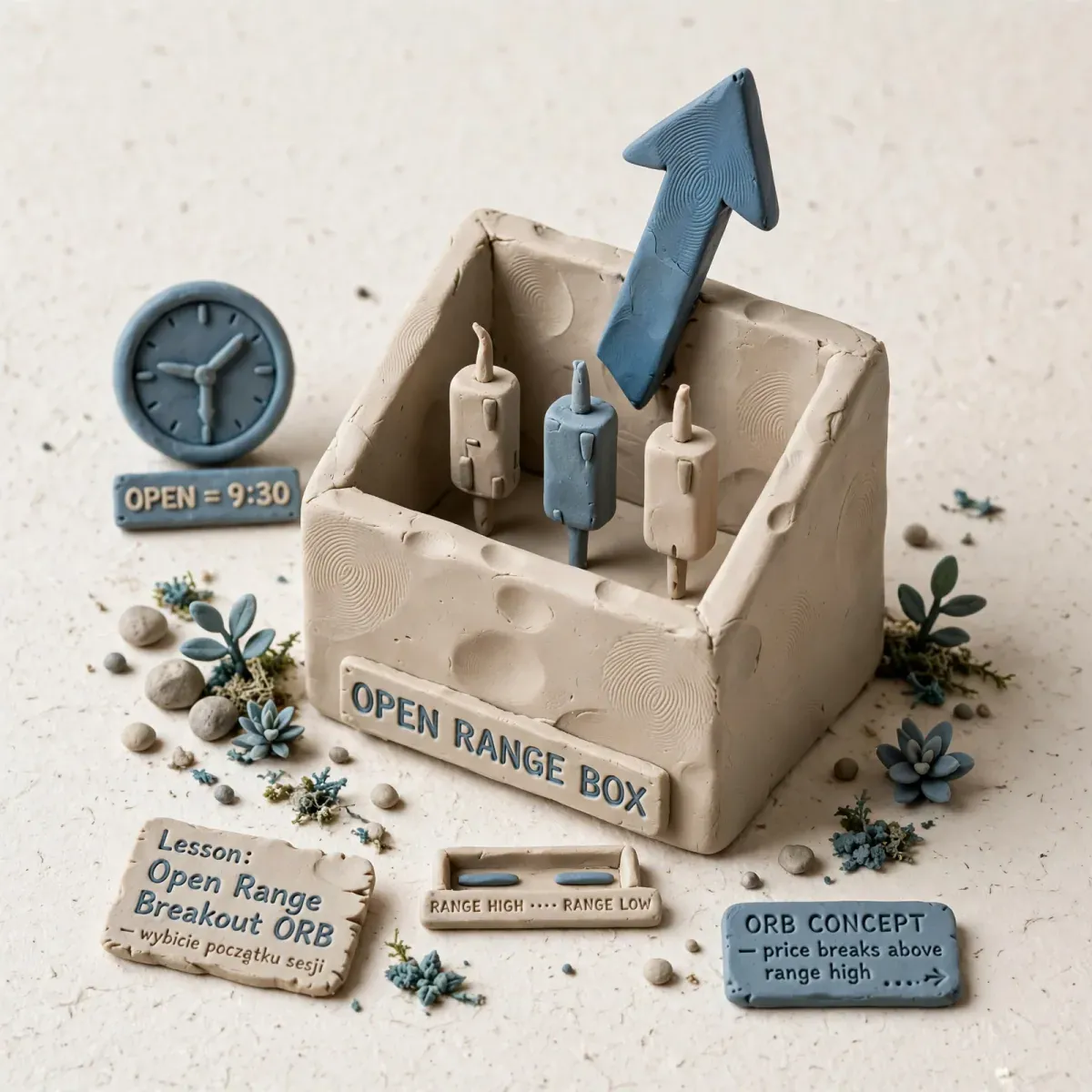
Open Range Breakout is one of the oldest day-trading patterns: you define the range of the first N minutes and trade the breakout from it. The strength of…
- Author
- Zordon Intelligence Sp. z o.o.
- Updated
- 6 min read
- Structure sources
- 2
Open Range Breakout is one of the oldest day-trading patterns: you define the range of the first N minutes and trade the breakout from it. The strength of ORB comes from the concentration of orders and volume at the open. The weakness is a large number of false breakouts on rotation days. Without filters and a strict stop, ORB is an overtrading machine.
Lesson goal
- Define the 5-, 15- and 30-minute ORB operationally.
- Measure ORB effectiveness under different gap and volume conditions.
- Write down the entry, stop and target rules with no discretion.
- Tell a continuation ORB apart from a false-breakout ORB.
ORB definition
OR_N = High of the first N minutes - Low of the first N minutes
OR_High = max price in [Open, Open+N]
OR_Low  = min price in [Open, Open+N]

Long entry: Close M1 > OR_High + buffer
Short entry: Close M1 < OR_Low - buffer

Buffer = 0.1 * OR_N or 0.05 * ATR 5m
Most commonly used: ORB 5m for momentum stocks, ORB 15m for indices, ORB 30m for filtering out noise.
Preconditions: when ORB makes sense
| Filter | Desired value | Why |
|---|---|---|
| Gap_ATR | 0.5 – 1.5 | Too small = no fuel, too large = exhaustion |
| OR_N vs ATR | OR_N 0.3 – 0.8 ATR 5m avg | Too narrow = stop-hunting, too wide = poor R:R |
| Volume of the first N min / avg | > 150% of the average | Confirms institutional participation |
| Distance to PM_H/PM_L | OR breakout in the direction of PM_H/PM_L | An extra liquidity level beyond the OR |
| Spread | < 0.05% | Protects against slippage on the breakout |
Three entry variants
- Classic breakout: buy / sell on the breakout of the OR High/Low plus the buffer. Stop on the other side of the OR or 1x OR_N.
- Retest: after the breakout you wait for a return to the OR High/Low and a rejection. Less slippage, lower win rate, better R:R.
- Failed ORB (fade): if the OR is very wide (>1.2 ATR) and volume falls after the breakout, you play the return to the middle of the OR. A counter-trend setup that requires VWAP confirmation.
Position management
Risk per trade: R = 0.25-0.5% of the account for ORB 5m, 0.5-1% for ORB 15m
Stop: OR_low for a long (or OR_high + buffer for a short) or the structural swing inside the OR
Target 1: 1 * OR_N or 1.5R – close 50%
Target 2: 2 * OR_N or the PM_H, PD_H level
Move to BE: after Target 1 is touched and a 5m close above it
Do not move the stop beyond the original plan. ORB is a game with time – if after 10 minutes it is not going your way, close at least 50%.
Measuring ORB effectiveness
WinRate_ORB = wins / all breakouts with filters applied
AvgWin_R, AvgLoss_R
Expectancy_R = WinRate*AvgWin_R - (1-WinRate)*AvgLoss_R
Max losing streak – does it fit inside your daily limit?
Keep a table split into: ORB 5m gap up, ORB 5m gap down, ORB 15m neutral. Those are 3 different systems.
ORB variants depending on the gap
Gap up + ORB long is classic momentum. But measure it separately:
- Gap up + breakout of OR_H in the direction of the gap – continuation, the highest WR with the volume filter.
- Gap up + breakout of OR_L – fading the gap, a play for the fill. It requires a wider stop and weaker volume on OR_L.
- Neutral open (gap <0.3 ATR) – ORB has the lowest expectancy there. That is where rotation happens.
Log 3 separate equity curves in your journal – the combined statistic lies, because it mixes different behaviours.
Numerical example
Yesterday's close 200, today's open 202, ATR D1 = 2.5 -> Gap_ATR 0.8 (normal)
OR 5m: 202.5 / 201.8 -> OR_N = 0.7, ATR 5m avg 0.35 -> OR_N / ATR = 2.0 (too wide)
Decision: do not trade the ORB 5m, switch to ORB 15m. If ORB 15m = 0.9 -> ratio 0.9/0.6=1.5 still too wide = wait for the retest, not the breakout.
Measuring slippage in ORB
Record 10 ORB breakouts. Compare Intended (trigger + buffer) vs Fill. If the average slippage is >0.15 * OR_N, change the market order to a limit-stop order or reduce your size.
Integration with VWAP
The best ORB is one that holds on the correct side of VWAP after the breakout. If you are long the ORB breakout and price drops below VWAP within 3 minutes of the breakout – that is a warning. Close 50% regardless of the plan. Statistically: a RETURN below VWAP after the breakout lowers the WR by 15-20% in tests on ES/SPY.
When the plan says DO NOT TRADE
- OR_N < 0.2 * ATR 5m avg – a dead market.
- OR_N > 1.5 * ATR 5m avg – the range is too wide, R:R < 1.
- Breakout volume < average volume – no continuation.
- Open in the middle of yesterday’s value area and a gap < 0.3 ATR – a rotation day.
- Two ORB losses on the same day – no more ORB trading today.
- News scheduled within 5 minutes (CPI, jobless) – do not trade ORB in the news window.
Mistakes that cost the most
- Missing buffer: entering at the exact OR_High = catching other people’s stops.
- A mental stop: “I will wait until it comes back”. ORB without a hard stop is a large gap loss.
- Increasing size after the first ORB win: opening euphoria plus leverage = giving the day back.
- ORB on everything: playing ORB on 5 stocks at once – impossible to manage.
- Ignoring time: a 9:35 ORB played at 11:30 is not an ORB, it is random.
Measurable exercise
Backtest 30 ORBs with filters.
- Pick 1 market (for example SPY, DAX, or a momentum stock).
- On M1 data from the last 20 sessions, mark out the ORB 5m.
- Apply the filters: only days where Gap_ATR is 0.5-1.5 and Vol OR / avg Vol >1.5.
- Simulate a long/short entry on the breakout + buffer 0.1OR_N, stop 1OR_N, target 2*OR_N.
- Record: WinRate, AvgR, the number of signals with filters vs without filters.
Check yourself
- OR 5m: high 101, low 100, buffer 0.1, ATR 5m avg 0.5. Where do you place the long trigger and the stop?
- Why does ORB have low effectiveness on a rotation day?
- Give the difference between the classic ORB and the retest in terms of slippage and R:R.
- What time rule will you introduce so that you do not hold a failed ORB position for an hour?
Frequently asked questions
Does a 1-minute ORB make sense? It has high noise and high costs. For most people 5m and 15m are more measurable.
Does ORB work on the Warsaw Stock Exchange (GPW)? Yes, but use ORB 15-30m because of lower liquidity and a slower open.
What if the breakout happens 1 second after the end of the OR? The close of the interval is what counts. If the 5m candle closes at 9:35 above the level, that is a signal.
Should you move the stop to break-even quickly? Compare the variant of BE after 1R vs BE after a 5m close above the level. Pick the one with the higher expectancy.
An educational model. ORB is a tool, not a guarantee of a breakout. Every configuration requires its own measurement on your market and your costs.
Advertisement
Key takeaways
- Open Range Breakout is one of the oldest day-trading patterns: you define the range of the first N minutes and trade the breakout from it. The strength of ORB comes from the concentration of orders and volume at the open. The weakness is a large number of false breakouts on rotation days. Without filters and a strict stop, ORB is an overtrading machine.
Structure sources
The material is based on source documents. Variable values — fees, limits, regulatory figures — are worth checking at the source before making a decision.
- Babypips — School of Pipsology — babypips.com
- TradingView — Pine Script documentation
Disclaimer
- Educational material. Not investment advice or a recommendation. Trading involves the risk of losing capital.
- The materials are educational. They are not investment advice or a recommendation within the meaning of financial instruments trading regulations. Numbers in examples are illustrative unless a measurement date and source are given.
Who writes this and how we check it
The materials are written and verified by Redakcja Kurs Tradera — the rules are described on about the site: every number has a source, and we show gaps openly. Report a factual error via contact — corrections are described in the content.
Progress is stored only in this browser (localStorage) — there is no account and no copy on the server. Clearing site data will remove it. Manage your data