Module 1 / 2
Day trading vs scalping vs swing - matching a style
Day trading, scalping and swing trading are not three versions of the same thing. They are three different jobs operating on different timeframes, each…
- Author
- Zordon Intelligence Sp. z o.o.
- Updated
- 6 min read
- Structure sources
- 2
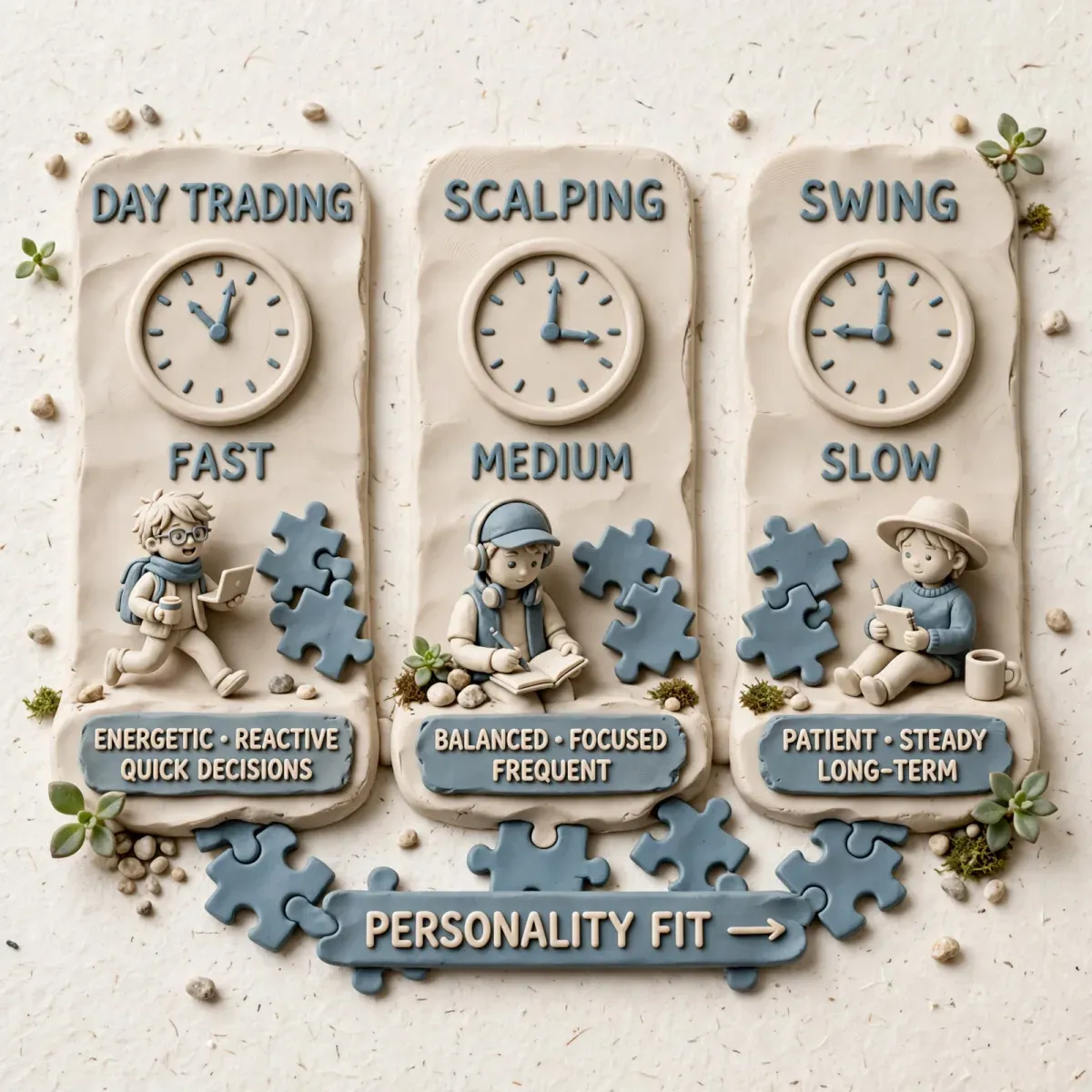
Day trading, scalping and swing trading are not three versions of the same thing. They are three different jobs operating on different timeframes, each requiring different infrastructure, risk management and mental resilience. The beginner’s mistake is choosing a style on the promise of profit instead of on available time, capital, transaction costs and tolerance for decision frequency.
This course does not recommend any style. It teaches you how to measure and assess each of them against your own conditions.
Lesson goal
After this lesson you will be able to:
- tell day trading, scalping and swing apart operationally,
- name the key costs and constraints of each style,
- match a style to your amount of time, type of attention and resources,
- calculate expectancy and the break-even cost threshold for your style.
Operational definitions
Scalping: intraday trades with a holding time from seconds to a few minutes. Goal: a small move, a high win rate or positive R asymmetry, very high frequency. It requires low commissions, fast execution, DOM / tape. The unit profit is close to the costs.
Day trading: intraday trades closed before the end of the session. Holding time from a few minutes to a few hours. Avoiding overnight risk. Reliance on session structures: the open range, VWAP, gaps.
Swing trading: positions held from 1 day to a few weeks. Decisions based on D1/W1. Lower frequency, higher exposure to overnight gaps, lower demands on execution speed.
Comparison of measurable parameters
| Parameter | Scalping | Day Trading | Swing Trading |
|---|---|---|---|
| Holding time | 5 sec – 5 min | 5 min – 6h | 1 day – 4 weeks |
| Trades / month | 200 – 1000+ | 20 – 100 | 4 – 20 |
| Main cost | Commissions + slippage, platform fee | Commissions, slippage on entry | Swap / gaps, commissions of low relevance |
| Attention required | Continuous, 100% focus, no breaks | Continuous within the trading window, e.g. 2-3h | Intermittent, 15-30 min / day |
| Key tool | DOM, Time & Sales, hotkeys | 1m/5m + VWAP + session profile | D1, levels, ATR |
| Main risk | Overtrading, costs eating the edge | Forcing trades outside an A+ setup | Overnight gap, size too large vs ATR |
Trading personality – a 5-question test
Do not assess your personality in psychological terms, only in operational ones:
- Can you go 90 minutes without making a decision when there is no setup? No = a problem in day trading and scalping.
- After 3 losses in a row, do you raise your stake or click faster? Yes = scalping is contraindicated without circuit breakers.
- Can you guarantee a steady 6-8 hours without distractions? No = swing is operationally safer.
- Do you accept that 60-70% of the time is waiting and analysis, not clicking? No = a high risk of overtrading.
- Do you have a measured transaction cost per round-turn? No = you cannot calculate the threshold for scalping.
Rule: you choose the style that minimises the number of situations in which your natural behaviour destroys the plan.
Formulas: break-even threshold and expectancy
Every style has to pass a mathematical test. Without it, it is guessing.
1. Expectancy per trade (in R or PLN):
Expectancy = (WinRate * AvgWin) - (LossRate * AvgLoss)
Expectancy_R = (WinRate * R_avg_win) - (LossRate * 1)  // if the loss = 1R
2. Minimum win rate at a constant RR:
WinRate_min = 1 / (1 + RR)
where RR = AvgWin / AvgLoss

For RR = 1.5: WinRate_min = 1 / 2.5 = 40%
For RR = 2.0: WinRate_min = 1 / 3 = 33.3%
3. Cost threshold for a scalper:
Round_turn_cost = commission + estimated_slippage
Gross_profit_per_trade >= Round_turn_cost * 1.5  // buffer
Required_R_min = (Round_turn_cost / Risk_per_trade) + 1
Example: you risk 40 PLN on a scalp, the cost is 4 PLN RT, so the cost alone is 0.1R. To make 0.2R net, you have to aim for at least 0.3R gross. If your system delivers an average of 0.25R gross, it is unplayable at these costs.
4. Time and attention filter:
Max_decisions_per_day = Available_focus_hours * 60 / Time_per_1_decision_min
If your strategy generates > Max_decisions, the style is incompatible.
How to measure which style is yours – a 2-week protocol
- Week 1: trade only one style, max 3 defined setups. Record every temptation to break the rules.
- Week 2: the second style.
- Compare the metrics: % of plan execution, deviation from size, number of trades outside the plan, emotional cost (a 1-5 scale after the session).
Choose the style with the highest % of plan execution, not the highest P&L on a demo.
When the plan says DO NOT TRADE
- You have no defined break-even threshold (win rate + RR + costs) for the style.
- You cannot guarantee an uninterrupted trading window (day trading/scalping).
- You scalp on an account with a commission > 0.1% and no measured slippage.
- You are choosing a style because “more opportunities = I will earn faster”.
- You have a daily loss limit and you have just hit it – changing style mid-day is forbidden.
The mistakes that cost the most
- Style-of-the-day: scalp today, swing tomorrow, because of boredom. No statistical sample.
- Ignoring costs: the edge exists only on the chart; after costs the expectancy is negative.
- Confusing activity with productivity: 40 trades a day without an edge is paid overtrading practice.
- Swing size in a scalp: moving 1% risk from D1 to M1 destroys the account in streaks.
- No definition of the end of the day: a day trader without a hard time cut-off starts holding overnight “because it did not work out”.
Measurable exercise (60 minutes)
Title: Threshold calculation for 3 styles.
- Check your broker’s fee schedule: commission, minimum commission, exchange fee. Write down the RT cost in PLN for your typical size.
- Assume 3 profiles: Scalp RR 1.2 / AvgLoss 0.8%, Day RR 1.8 / AvgLoss 0.6%, Swing RR 2.5 / AvgLoss 1.2%
- For each, calculate WinRate_min and add the cost.
- Answer: at your RT cost, what minimum average gross profit must a scalp deliver for the net to be >0? Write it in the table.
- Rate each style 1-5 for: available time, resilience to boredom, tolerance for fast decisions.
Result: a 3x3 table with the thresholds and a compatibility rating. The decision comes only from the numbers, not from what you want.
Test yourself
- You have a day trading system with RR 2.0 and WinRate 35%. What is the expectancy in R? Is it positive?
- Scalp: risk 50 PLN, average gross profit 55 PLN, RT cost 6 PLN. What are the net profit and the expectancy if WinRate = 55%?
- Why is scalping on an account with a minimum commission of 5 PLN per trade at a size of 500 PLN doomed to fail even with a good system?
- What does it mean that a style is operationally incompatible, even if it has a positive expectancy in a backtest?
Frequently asked questions
Can I combine styles? Yes, but as two separate playbooks with separate limits, journal and risk. Not within the same session without a clear rule.
Is scalping only for large accounts? It is above all for low costs and very high discipline. Account size is a secondary filter.
Which style is the easiest to start with? Risk is easiest to measure and control in swing and low-frequency day trading. Scalping carries the largest technology and cost overhead.
Do I have to choose once and for all? No. You choose for 100 trades of a forward test. After the sample, re-evaluate based on the journal.
This content is educational and is not investment advice. Every trading decision should account for your own costs, risk, and testing on historical and simulated data.
Advertisement
Key takeaways
- Day trading, scalping and swing trading are not three versions of the same thing. They are three different jobs operating on different timeframes, each requiring different infrastructure, risk management and mental resilience. The beginner's mistake is choosing a style on the promise of profit instead of on available time, capital, transaction costs and tolerance for decision frequency.
Structure sources
The material is based on source documents. Variable values — fees, limits, regulatory figures — are worth checking at the source before making a decision.
- Babypips — School of Pipsology — babypips.com
- TradingView — Pine Script documentation
Disclaimer
- Educational material. Not investment advice or a recommendation. Trading involves the risk of losing capital.
- The materials are educational. They are not investment advice or a recommendation within the meaning of financial instruments trading regulations. Numbers in examples are illustrative unless a measurement date and source are given.
Who writes this and how we check it
The materials are written and verified by Redakcja Kurs Tradera — the rules are described on about the site: every number has a source, and we show gaps openly. Report a factual error via contact — corrections are described in the content.
Progress is stored only in this browser (localStorage) — there is no account and no copy on the server. Clearing site data will remove it. Manage your data