Module 2 / 2
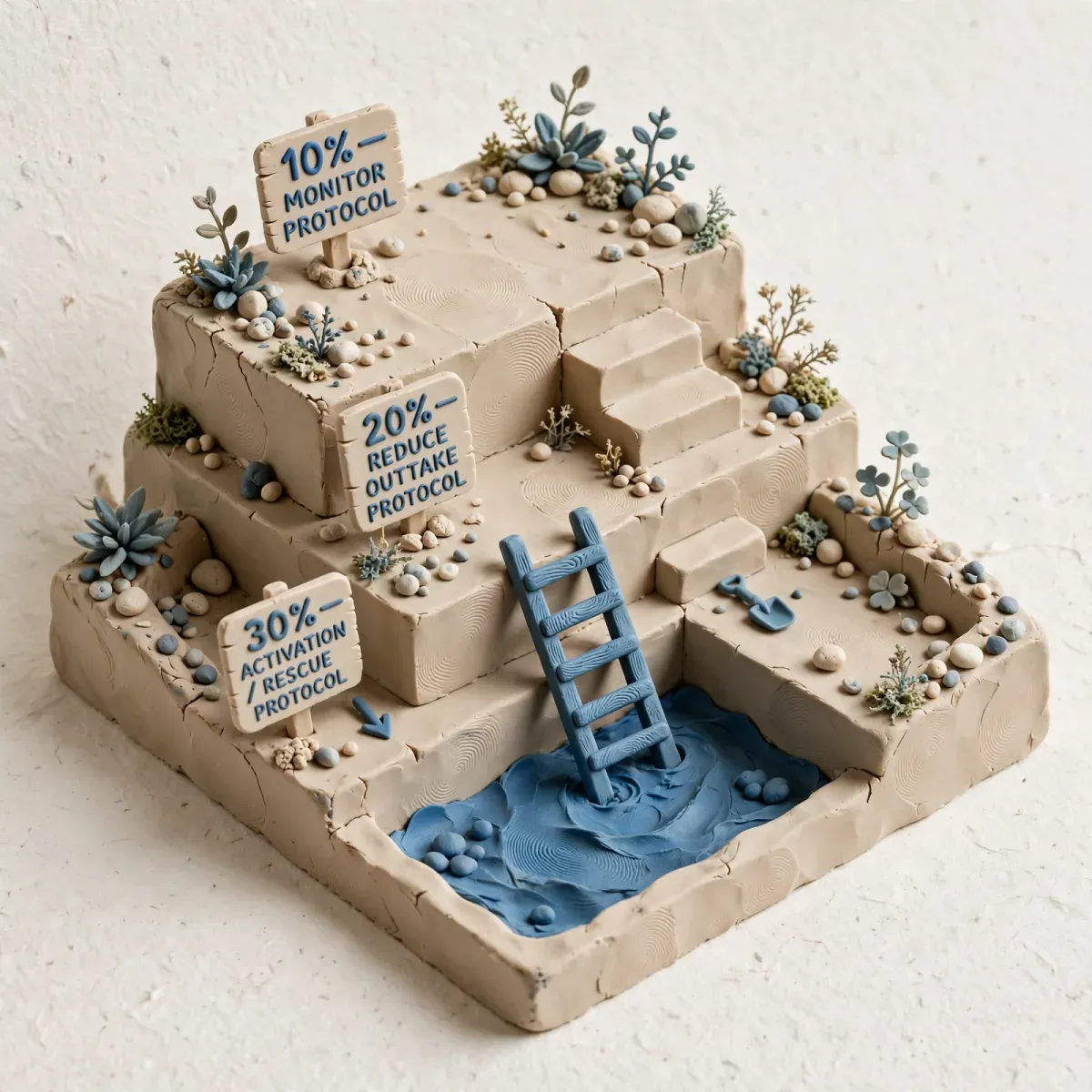
Working with drawdown - protocols for 10%, 20%, 30%
Drawdown is not an anomaly. It is a fixed cost of running a trading business. Every system, even one with a 60% win rate and R=2, will have a run of 8-12 losses in a row within a year. The question is not "will you be in drawdown", but "what will you do when you are in it". Most traders...
- Author
- Zordon Intelligence Sp. z o.o.
- Updated
- 10 min read
- Structure sources
- 2
Drawdown is not an anomaly. It is a fixed cost of running a trading business. Every system, even one with a 60% win rate and R=2, will have a run of 8-12 losses in a row within a year. The question is not “will you be in drawdown”, but “what will you do when you are in it”. Most traders do not have a protocol - they have hope. Hope is not a strategy for -20%. This lesson gives you 3 levels of protocol.
What drawdown really is
Drawdown is the decline in capital from the most recent peak.
Drawdown_% = (Peak_Capital - Current_Capital) / Peak_Capital * 100%

Example: peak 10,000 PLN, currently 9,000 PLN -> DD 10%
Maximum Drawdown (MaxDD) is the largest DD in the account's history.
But drawdown has two layers:
- Mathematical: how much you must earn to get back to the peak.
- Psychological: how much pain you can take before you abandon the system or start breaking the rules.
| Drawdown | Return needed to recover | Psychological effect |
|---|---|---|
| -10% | +11.1% | Discomfort, the beginning of doubt |
| -20% | +25% | Anxiety, the temptation to raise risk, hunting for a new system |
| -30% | +42.9% | Pressure, revenge, thoughts of quitting, chronic cortisol |
| -50% | +100% | Psychological ruin for most people |
That is why professional drawdown management starts BEFORE it happens, by defining thresholds and actions.
The formula for risk of ruin in drawdown:
Required_WinRate_after_DD = Loss_to_recover / (Average_R * Size)

If after a 20% DD you cut size by 50%, you need 2x as many trades to recover.
That stretches out the time, but lowers the risk of a deeper DD.

Rule: in DD size goes down, not up. The opposite is the road to -50%.
Level 1: 10% drawdown - yellow alert
-10% is normal noise in most swing / intraday strategies with 0.5-1% risk per trade. If you risk 1% per trade, 10 losses in a row = -10%. The probability of 10 losses at a 45% win rate is ~0.025% per sequence, but in a year you make 200-250 trades = statistically 1-2 such runs.
Signature: you start calculating “how much is missing to break even”, you check P&L more often, the thought “is the system still working?” shows up.
DD10 protocol:
1. STOP and MEASURE (30 min without a chart):
   - Count the system's historical MaxDD (from the backtest / journal). Is the current DD within the historical range? If YES -> normal.
   - Count Plan_Adherence over the last 20 trades. If <80% -> this is not the system's DD, it is an execution DD.

2. REDUCTION and FOCUS:
   - Size: -25% (if the base is 1% -> now 0.75%)
   - Max trades per day: -1 (if 3 -> 2)
   - Setup A only (the best one). Setups B/C switched off until you exit the DD.

3. DD JOURNAL:
   - Ask: were the last 5 losses consistent with the plan? If YES -> continue. If NO -> go back to Lesson 04, this is not DD, this is tilt.

4. COMMUNICATION: if you have an accountability partner / group - tell them: "I am in DD10, I am cutting size".| Metric | Target in DD10 | Action if outside the target |
|---|---|---|
| Plan Adherence | >=85% | Stop trading, review the recordings |
| Average losing R | ≤1.1R | Check slippage, check whether you are moving the stop |
| Morning emotion | ≤5/10 | Apply the sleep / meditation protocol from Lesson 03 |
Level 2: 20% drawdown - red alert
-20% is a serious test of both the system and your psychology. This is where most people abandon the strategy and start “looking for a better one”. That is the most expensive mistake: changing the system in the middle of a DD resets your statistics and guarantees you will never build a sample.
Signature: rumination, checking the account at night, avoiding opening the platform or the opposite - staring at it too much, arguments at home, thoughts of “I have to make it back fast”.
DD20 protocol:
1. HARD STOP 48h (minimum 1 full day away from the market):
   - Close every platform. No trading for 24-48h.
   - During that time: a full review of the last 30 trades (setup, R, emotion, compliance).
   - Answer 3 questions on paper:
     a) Has the market changed regime? (e.g. no trend, low volatility)
     b) Have I changed my behaviour? (sleep, stress, breakers)
     c) Has the system historically had a DD like this? (check a 2-3 year backtest)

2. Aggressive DOWNSIZING:
   - Size: -50% to -75% (from 1% -> 0.5% or 0.25%)
   - Trade only on a demo account, or at 25% position size for 5 days after you return (re-entry protocol)
   - Goal: regain compliance, not P&L.

3. REGIME CHECKLIST:
   - If the market regime has changed (e.g. your trend system is stuck in a 3-week consolidation):
     The plan says: cut frequency, do not raise it. Accept that some months are 0R.
   - If it is an execution error: go back to Lesson 04, 10 days at 50% size, 100% compliance.

4. WEEKLY LIMIT:
   - MAX weekly loss = -5R. Once you hit -5R in a week - the week is over. No discussion.
The formula for time to recover:
Trades_to_recover = (DD_% / (Avg_R * WinRate * Risk_per_trade)) * Reduction_factor

Example: DD 20%, Avg_R 1.8, WR 45%, risk 0.5% after the cut
Required gain = 25%
25% / (1.8*0.45*0.5%) = 25% / 0.405% = ~62 planned trades

If you take 3 trades a day = 21 trading days. That is a realistic horizon, not "I will make it back tomorrow".
Accepting a 3-4 week horizon lowers the pressure and prevents revenge trading.
Level 3: 30% drawdown - survival protocol
-30% is the level at which 80% of retail traders make a critical mistake: they either double their stake, quit trading, or borrow capital.
If you got to -30% with 1% risk per trade, that means: either you have 30 losses in a row (extremely unlikely with a good system), or you broke your risk rules and averaged down, or the system has no edge and you did not notice earlier.
DD30 protocol:
1. TOTAL STOP - a week away from the market (5 business days):
   - Zero charts. Zero trading Twitter / X.
   - Task: write a DD30 report on 1 A4 page:
     - DD start date, peak, current DD
     - How many trades, what % consistent with the plan
     - What the average R was and whether you increased size along the way
     - Were breakers broken? How many times?

2. CAPITAL AUDIT:
   - Can you keep trading this capital without financial pressure?
     If -30% means you cannot pay your bills - that is not a trading problem, it is a life-size problem. Cut your trading capital down to an amount whose loss does not affect your life.
   - Rule: trading capital is capital whose loss does not change your life for 6 months.

3. GO / NO-GO DECISION (after the week):
   - If Plan Adherence <70% during the DD: the problem is execution. Go back to Lessons 02-04, 30 days demo / micro lot.
   - If Plan Adherence >85% and the system's historical MaxDD is, say, 25% while you are at -30%: the system has exceeded its historical MaxDD by 5%. That is a signal that the edge may be fading or the regime has changed. Cut risk permanently to 0.25% or pause the system and start a forward test at a smaller size.
   - If you broke your risk rules (averaging down, no stop): immediately 0.25% risk, 1 trade a day max, a mentor / accountability, or a 1-month break.

4. RE-ENTRY PLAN (if GO):
   - Week 1-2: 0.25% risk, setup A only, max 1 trade a day, 100% of the checklist
   - Week 3-4: 0.5% risk if compliance is 100% and the DD is not deepening
- Back to 100% size only after recovering 50% of the DD (that is, from -30% to -15%) and 20 trades in a row consistent with the plan.| Mistake in DD30 | Why it kills the account |
|---|---|
| Doubling the stake (martingale) | -30% -> -60% in 5 trades at 2x size |
| Borrowing capital “to make it back” | Financial pressure = chronic cortisol = worse decisions |
| Changing the system every day | You never build a sample, you are always in the learning phase of a new one, that is, the losing phase |
When the plan says: do not trade
- When you are in a 20% DD and you have not taken the 48h break + the 30-trade report. Trading without an audit in a DD20 is like driving with smoke coming out of the engine without looking under the hood. The plan says STOP until the audit is done. Repeating the same behaviour will deepen the DD to 30%.
- When you are in a DD10 with Plan Adherence <80% and you are still trading full size. That is not the system’s DD, it is your DD. Before you add to the system’s losing sample, you have to fix execution. Full size at <80% compliance is a guaranteed DD20.
- When after a DD30 you feel relief that “it cannot get any worse” and you want to “go all in”. That is euphoria from the bottom, which is just as dangerous as euphoria from the top. This is the moment when the brain looks for a quick reward to reduce the pain. The plan says: a week away from the market and an audit of your life capital. The market does not have to come back.
The mistakes that cost the most
Mistake 1: No pre-defined DD10/20/30 thresholds before you start trading. If you define the protocol only once you are in a DD, you are already in the emotion and you will not apply it. The thresholds must be written into the plan while you are at a peak, calm. Then it is a decision, not a discussion.
Mistake 2: Judging the system after 10 trades in a DD instead of after 100. A system with a 45% win rate has natural runs of 6 losses in a row. After 10 trades in a DD you know nothing. You need 30-50 trades consistent with the plan to judge whether this is variance or a missing edge. Traders cut systems after 10 losses and never give them a chance to show the edge over 100 trades.
Mistake 3: Raising risk in a DD to “make it back faster”. The maths: after -20% you need +25%. If you double your risk, you need half as many trades, but the risk of another -20% (that is, -40% in total) grows exponentially. One extra run of 5 losses at 2x size = -10% more, so -30% in total. Instead of 25% to recover you have 43%. Death spiral. Professionals do the opposite: in a DD risk goes down.
Measurable exercise
Goal: build DD protocols and rehearse them on your history.
Steps:
- Pull your account / journal history - at least 100 trades. Find your current or most recent MaxDD.
- Calculate:
MaxDD_% = (Peak - Trough)/Peak
DD_duration_days = trough date - peak date
Plan_Adherence_in_DD vs outside DD
Average_R_in_DD vs outside DD-
Write the 3 DD10/20/30 protocols into your plan (copy them from the lesson and adjust the thresholds to your own risk). Write them on a card next to your monitor.
-
Run a paper simulation: you are in a 15% DD (from 10k down to 8.5k). Your risk is 1% -> 0.75% after the cut. Calculate how many trades you need to get back to 10k if Avg_R=1.5, WR=45%. Write down the horizon in days.
-
Over the next 30 days, if you enter a DD10, apply the protocol and record whether you followed it Y/N.
Pass criterion: you have the 3 protocols written down in your plan, your historical MaxDD calculated, and one simulation of the time to recover. If there was a DD10 within 30 days - you have an entry on whether the protocol worked and what the effect on Plan_Adherence was.
Test yourself
- What % return is needed to recover -10%, -20%, -30%? Give the formula and calculate.
- Describe the difference between mathematical and psychological DD. Which one is more dangerous for a retail trader?
- Give the DD10 protocol - the 4 steps. When do you cut size, and when do you switch off setups B/C?
- In a DD20 - why is the 48h hard stop mandatory? What should the 30-trade audit contain (the 3 questions)?
- You are at -30% with 1% risk per trade and 70% compliance. What is the GO/NO-GO verdict and what is the re-entry plan?
Frequently asked questions
Is a 10% DD a lot or a little? Does it depend on the strategy? Yes, it depends on your risk and your frequency. For a day trader at 1% risk, 3 trades a day, a DD10% = 10 losses = one weaker week. For a swing trader at 0.5% risk, 5 trades a month, a DD10% = 20 losses = 4 months. That is why you judge a DD against your own historical MaxDD and risk-per-trade, not in absolute terms. If your historical MaxDD is 15%, then a DD10 is within normal.
When should you change the system, and when should you keep it? Only after 3 conditions are met: 1) Plan Adherence >85% over at least 50 trades in the DD, 2) current DD > historical MaxDD + a 20% buffer (e.g. historical 20%, now 25%+), 3) a regime change confirmed objectively (e.g. ATR down 50%, trend score) for >4 weeks. If any of these is missing, the problem is execution or variance, not the system.
Does hedging help in a DD? Random hedging (opening opposing positions without a plan) in a DD usually deepens the DD, because it raises costs and blurs your focus. A professional hedge is a pre-defined part of the plan (e.g. beta reduction), not an emotional reaction during the DD. In retail - in a DD cut your size and the number of markets, do not add opposing positions “on a hunch”.
Advertisement
Key takeaways
- Drawdown is not an anomaly. It is a fixed cost of running a trading business. Every system, even one with a 60% win rate and R=2, will have a run of 8-12 losses in a row within a year. The question is not "will you be in drawdown", but "what will you do when you are in it". Most traders...
Structure sources
The material is based on source documents. Variable values — fees, limits, regulatory figures — are worth checking at the source before making a decision.
- Mark Douglas — "Trading in the Zone"
- Brett Steenbarger — "The Psychology of Trading"
Disclaimer
- Educational material. Not investment advice or a recommendation. Trading involves the risk of losing capital.
- The materials are educational. They are not investment advice or a recommendation within the meaning of financial instruments trading regulations. Numbers in examples are illustrative unless a measurement date and source are given.
Who writes this and how we check it
The materials are written and verified by Redakcja Kurs Tradera — the rules are described on about the site: every number has a source, and we show gaps openly. Report a factual error via contact — corrections are described in the content.
Progress is stored only in this browser (localStorage) — there is no account and no copy on the server. Clearing site data will remove it. Manage your data