Module 1 / 2
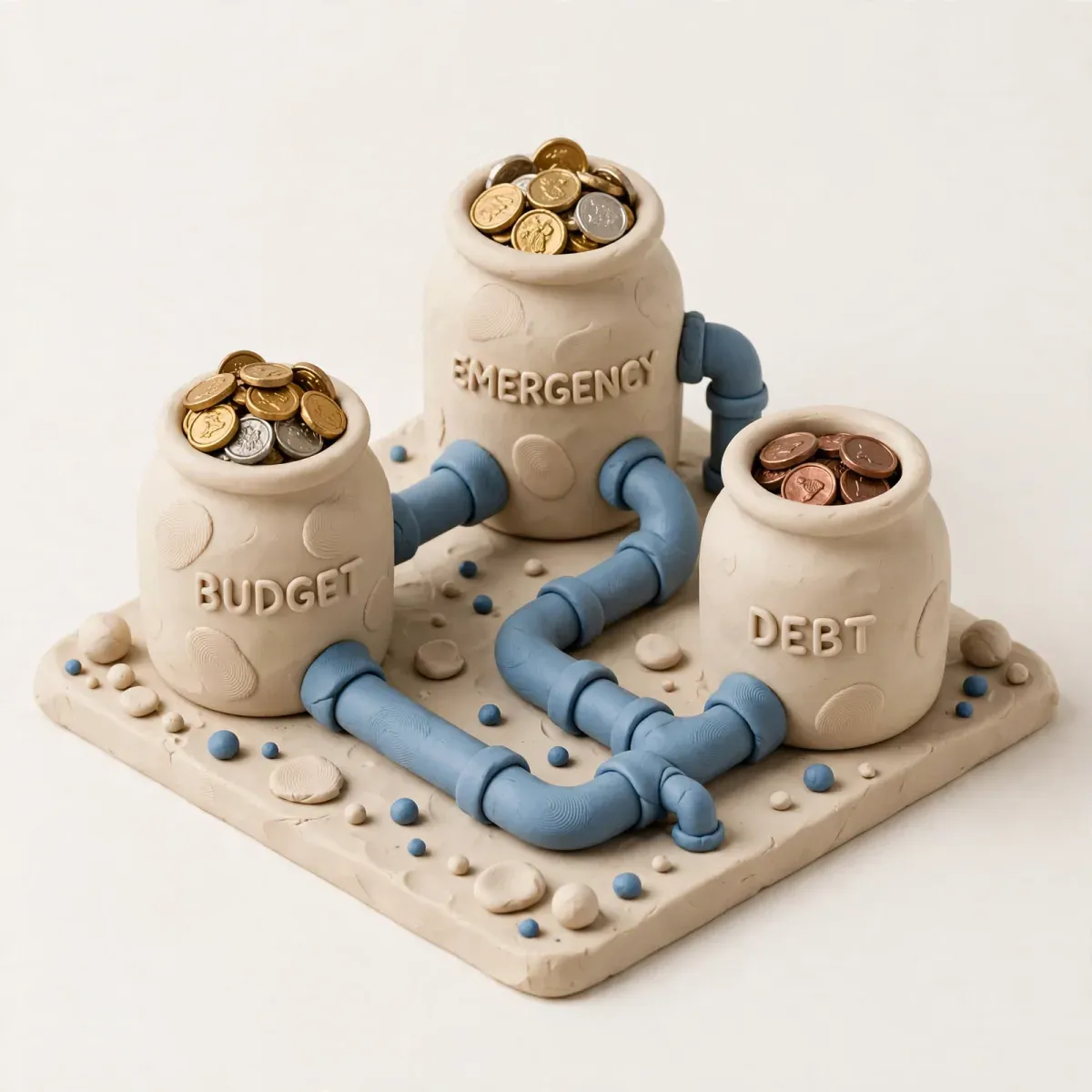
Budget, emergency fund and debt — the three-account system
Without a budget there is no measurement. Without measurement there is no risk management. Traders who meticulously measure their risk-to-reward ratio and…
- Author
- Zordon Intelligence Sp. z o.o.
- Updated
- 10 min read
- Structure sources
- 2
Course 14: Personal Finance and Building Capital
This material is for educational purposes only. It is not investment or financial advice. The examples serve only to illustrate the principles of budget and risk management.
Without a budget there is no measurement. Without measurement there is no risk management. Traders who meticulously measure their risk-to-reward ratio and win rate often cannot answer a simple question: how much does their life cost this month? That gap makes trading decisions emotional rather than numeric. In this lesson you will build a three-account system and a simple budget that separates life from the market.
The goal of this lesson
After this lesson you will be able to:
- Build a budget with the 50/30/20 method, in the trader version.
- Set the target size of your emergency fund and plan its build in weeks.
- Apply the two debt repayment methods — avalanche and snowball — and calculate the difference.
- Implement a three-account system that automates the separation of your finances.
Why a trader’s budget has to be different
A classic household budget assumes a fixed income. A trader’s budget must assume variable income and periods with no market income. That is why we split it differently.
You have three goals competing for every PLN:
- Maintaining current liquidity.
- Reducing the cost of debt (interest).
- Building capital for trading and investing.
Without allocation rules you will always prioritise the goal that shouts the loudest — usually the market.
The mechanics: the 50/30/20 budget, trader version
The original 50/30/20 rule (needs / wants / savings) is the starting point. For someone building trading capital we modify it:
Net income = 100%

50% = Hard needs (MCU = monthly cost of living) -> Account 1: Current account
20% = Wants / psychological buffer
30% = Financial goals (debt + emergency fund = WFA in months of MCU + trading capital)
For a retail trader with debt and no emergency fund, the split inside those 30% is critical:
| Priority | Allocation from the 30% pool | Goal | Condition to move on |
|---|---|---|---|
| Step 1 | 100% of the pool to WFA=1 | 1 month of MCU | Ensures survival |
| Step 2 | 100% of the pool to debt above 10% | Paying off cards / payday loans | Eliminating the most expensive risk |
| Step 3 | 50% fund / 50% debt at 5-10% | Building to WFA=3 + repaying cheaper debt | The golden middle |
| Step 4 | 70% fund / 30% trading capital | Pushing to WFA=6 | Only here do you start adding to the account |
| Step 5 | 50% long-term investments / 50% trading | Growing capital | You have a buffer, you carry no expensive debt |
This is not advice, only a framework for the sequence. The order follows from the mathematics of risk and the cost of capital.
How to build an emergency fund - measuring it in weeks
The goal “build 6 months” is abstract. Turn it into a number of weeks.
The formula for your build rate
fund_target = MCU * target_WFA
missing_amount = fund_target - current_fund
weekly_contribution = (monthly_goal_pool / 4.33)

time_in_weeks = missing_amount / weekly_contribution
Example:
- MCU = 6,000 PLN
- WFA target = 6 → 36,000 PLN
- Current fund = 6,000 PLN (WFA=1)
- Monthly pool for goals = 2,000 PLN
- Missing: 30,000 PLN
- Time = 30,000 / 2,000 = 15 months = 65 weeks
15 months sounds long, but 65 weeks with a weekly checklist is a measurable plan. Every week you tick off the deposit and update your WFA.
Where to keep the emergency fund:
- A savings account with instant withdrawal
- An account you do NOT see in your brokerage app
- Not in stocks, not in crypto, not in an ETF, not in a CFD broker account. It should be boring, liquid and unchanging.
Debt: two methods and the mathematics
Consumer debt is negative compound interest. It works every day.
The avalanche method - mathematically optimal
You sort your debts from the highest interest rate — the annual percentage rate (RRSO) — to the lowest. You pay the minimum on all and throw the whole surplus at the one with the highest RRSO.
interest_savings = highest with this methodThe snowball method - behavioural
You sort your debts from the lowest balance to the highest. You clear the smallest debt in full for a quick psychological win.
motivational_effect = high, interest_cost = slightly higherA comparison on an example
| Debt | Balance | APR (RRSO) | Min. payment |
|---|---|---|---|
| Card A | 2,000 PLN | 19% | 100 PLN |
| Phone instalment | 1,500 PLN | 8% | 150 PLN |
| Payday loan | 3,000 PLN | 45% | 300 PLN |
- Avalanche: the payday loan first (45%), then Card A (19%), and the phone last (8%). You will pay the least interest.
- Snowball: the phone first (the smallest balance? not here — the card is 2,000 against the phone’s 1,500), so phone -> Card A -> payday loan. You close 1-2 debts quickly, but the payday loan grows the longest.
The practical recommendation for a trader: if the RRSO difference is more than 10 percentage points, choose the avalanche. If all your debts carry a similar RRSO, the snowball can give you momentum.
The formula for the monthly cost of debt:
monthly_interest_cost = balance * (RRSO / 12)

Payday loan example: 3000 * (0.45 / 12) = 112.5 PLN per month in interest alone
That is your “negative edge”. No trading system is as stable as a 45% cost.
The three-account system - automating separation
The goal: zero decisions based on willpower on payday.
Account 1 - Operating: Your salary lands here. You pay your MCU from it. It should have standing orders attached and a card for purchases.
Account 2 - Safety buffer: A savings account at a different bank (psychological friction when withdrawing). An automatic transfer from Account 1 on payday. This is where you build your WFA.
Account 3 - Trading (at your broker): Only capital whose total loss will not push your WFA below 3. Funded monthly by a transfer from Account 1 (part of the 30% pool), never “on the fly” after a loss.
The flow diagram:
Income -> Account 1 (100%)
Account 1 -> Account 2 (automatic, X PLN for the emergency fund / debt)
Account 1 -> Account 3 (automatic, Y PLN for trading, only if your WFA >= 3 and there is no debt above 10%)
Account 1 -> Life (MCU + wants)
That way you never decide “should I top up the broker account”. The decision lives in the automation and the WFA rule.
When the plan says do not trade
When the plan says: DO NOT TRADE
In the context of a budget and debt, the filter is even stricter than in Lesson 01:
DO NOT TRADE (or add to your account) IF:
- You do not know your MCU to within +/- 10%. Without measurement there is no management. Take 7 days to count your expenses from your statements.
- You carry active debt at an RRSO above 15% and are not paying it down aggressively. Trading against a 20% card cost is like playing with a -20% spread in the background.
- Your WFA fell this month by more than 0.5 of a month because of unplanned spending. Rebuild the buffer first. The market will wait.
- You have already broken your budget twice this month (overspending on wants) and covered it from Account 2. That signals an unrealistic budget or missing discipline. Trading will add one more variable.
- You are funding Account 3 from a credit card, a credit limit, a loan. Immediate stop.
In those situations your job is to rebuild the spreadsheet, not to open a position.
The mistakes that cost the most
1. A budget in your head, not on paper. Your brain understates spending by 20-30%. Only a statement plus a spreadsheet gives you the truth. Every PLN without a category is future debt.
2. An emergency fund at 0% in the bank + inflation. Keeping 30k in a personal current account with no interest is a loss. The fix: a savings account at 5-7% (at present). It is not about profit, only about limiting erosion and keeping the money separate.
3. Paying only the minimum on your cards. The minimum is designed so that you pay for as long as possible. Example: 10k of debt at 19%, minimum 3% = 15 years of repayment and 8k of interest.
4. A “consolidation loan” with no change in habits. You consolidate, clear the cards, then load them up again. The debt grows from 15k to 30k. Consolidation without cutting spending and closing credit limits is postponing the problem.
5. Mixing the household budget with trading results. “I made +2,000 PLN on trading this month, so I can spend more.” That makes the household budget depend on a high-variance variable. Base the household budget on fixed income. Trading profit is a surplus you allocate only after the month closes.
Measurable exercise [25 minutes]
Name: The 3-Account Spreadsheet
- 10 min - MCU: Pull your statements from the last 90 days. In a spreadsheet (Google Sheets / Excel) create categories: Housing, Food, Transport, Bills, Debts (instalments), Insurance, Other fixed. Average them — that is your MCU.
- 5 min - Fund: Enter the current balance of Account 2. Calculate your WFA. Calculate
target = MCU * 6. Calculate the shortfall and the weeks per the formula. - 5 min - Debts: A table with all your debts: creditor, balance, RRSO, min. payment, date. Sort it twice: once by RRSO (avalanche), once by balance (snowball). Calculate the monthly interest cost.
- 5 min - Automations: Set up 2 standing orders at your bank for the day after payday: 1) to Account 2 (fund/debt), 2) to Account 3 (trading, only if you meet WFA>=3). Amounts per the priorities in the table.
Completion measure: Do you have a file with 3 numbers at the end of the exercise: MCU, WFA, monthly interest cost? If so - passed.
Test yourself
Question 1: You earn 8,000 PLN net. MCU = 5,500 PLN. You have 7,000 PLN in your emergency fund and 4,000 PLN of debt on a card at 18%. How should you divide the 30% pool (2,400 PLN)? Answer: The priority is eliminating debt above 10%. WFA = 7000/5500 = 1.27, so you have only a minimal buffer. First throw 2,400 PLN (or more, from your wants) at the card to close it in 2 months. Once the card is closed, the whole 2,400 PLN pool builds your WFA to at least 3. Only then do you fund trading.
Question 2: Why does keeping the emergency fund at a bank other than your current account help? Answer: It introduces friction. An interbank transfer takes hours, requires logging in and thinking it over. It reduces impulsive reaches into the reserve for wants or for “an opportunity in the market”. It is environment design, not willpower.
Question 3: You have two debts: 5,000 PLN at 5% and 1,000 PLN at 19%. Which repayment method gives the faster psychological effect, and which the mathematical one? Answer: Fast psychological effect: the snowball - you pay off the 1,000 PLN at 19% (because it is the smallest balance) and you close one debt. Mathematically: the avalanche also tells you to pay the 1,000 PLN at 19% first (the highest RRSO), so in this example both methods point to the same debt. The differences appear with a different configuration of balances and rates.
Frequently asked questions
Do I have to cut all my wants to zero? No. A budget that is a punishment will not survive 2 weeks. Keep the 20% pool for wants deliberately. The point is that you know how much you spend on them and do not fund them from the emergency fund or the trading account.
Where exactly should I keep the emergency fund? Savings accounts, bonds? The emergency fund has to be liquid within 24-48h and must not lose value in nominal terms. The simplest: a savings account. Not retail government bonds with a 3-month holding period, not a fixed-term deposit that forfeits interest on early withdrawal (which discourages you from touching it), not an ETF. Only once you reach WFA 6+ can you keep the surplus above 3 months in a slightly less liquid form, but that is outside the scope of this lesson.
I have irregular income (B2B, contract work). How do I calculate MCU and the budget? Calculate MCU as the average over 6 months. Take the income for your budget as the lowest of the last 3 months (a conservative assumption). In months with a surplus, 50% goes to raising your WFA. The target for irregular income is a WFA of 9-12, not 6.
Do I count the credit limit on my credit card as part of the emergency fund? No. A limit is not your capital, it is debt ready to be used. The emergency fund is only assets you own and can withdraw without increasing your debt.
Summary: A budget is a decision filter. Your WFA is the fuel that lets you not trade under pressure. Consumer debt is a negative edge that eats every profit from the market. The three-account system automates good decisions. Implement it once, then just measure.
In the next lesson: We will calculate how much capital you really need to start trading, why a 500 PLN account is an educational account, not an income one, and how to calculate the minimum capital for statistical significance.
Advertisement
Key takeaways
- Without a budget there is no measurement. Without measurement there is no risk management. Traders who meticulously measure their risk-to-reward ratio and win rate often cannot answer a simple question: how much does their life cost this month? That gap makes trading decisions emotional rather than numeric. In this lesson you will build a three-account system and a simple budget that separates life from the market.
Structure sources
The material is based on source documents. Variable values — fees, limits, regulatory figures — are worth checking at the source before making a decision.
- ECB (BCE) — guide to personal finance — ecb.europa.eu
- Polish Financial Supervision Authority (KNF) — financial knowledge base — knf.gov.pl
Disclaimer
- Educational material. Not investment advice or a recommendation. Trading involves the risk of losing capital.
- The materials are educational. They are not investment advice or a recommendation within the meaning of financial instruments trading regulations. Numbers in examples are illustrative unless a measurement date and source are given.
Who writes this and how we check it
The materials are written and verified by Redakcja Kurs Tradera — the rules are described on about the site: every number has a source, and we show gaps openly. Report a factual error via contact — corrections are described in the content.
Progress is stored only in this browser (localStorage) — there is no account and no copy on the server. Clearing site data will remove it. Manage your data